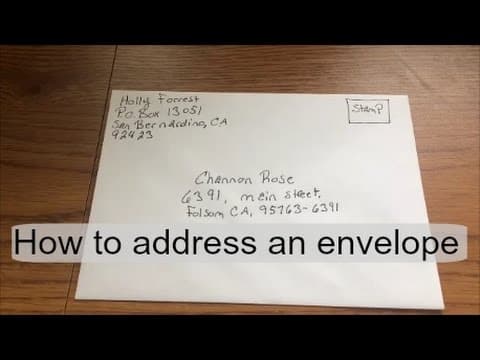
USPS First-Class Mail covers everything most people send: greeting cards, paper checks, paperwork, anything that fits in a standard envelope under 3.5 ounces. The video walks through which stamps you actually need for which letter type, and what to do when the standard rules don't fit (square envelope, heavier than 1 oz, going overseas).
The everyday case: drop a Forever stamp on a standard envelope, drop it in a USPS blue collection box. Done in 30 seconds. Everything below covers the variations on that.
Variations beyond the standard letter
Heavier letters (over 1 ounce). A Forever stamp covers up to 1 oz. Each additional ounce needs an "additional ounce" stamp (a smaller-denomination stamp the USPS sells alongside Forever stamps). Two-stamp letters are common for thick greeting cards, multi-page checks, or anything mailed in a padded envelope.
Square envelopes (wedding invitations, fancy cards). Need extra postage regardless of weight because they're "non-machinable" - the auto-sort can't process square shapes, so a human has to hand-sort them. As of 2026 the surcharge is about $0.40 over a standard Forever stamp.
International mail. Use a "Global Forever" stamp (one stamp, any country, up to 1 oz). Don't put a regular Forever stamp on international mail; it'll either be returned to you or charged to the recipient on arrival. For packages, use the USPS Postage Price Calculator - international rates depend on country, weight, and customs declarations.
Certified, registered, or tracking. Anything that needs proof of delivery (legal documents, tax returns, contracts) goes to a post office counter, not a blue box. The clerk adds a tracking barcode and you get a receipt with a number you can monitor online.
Semi-postal stamps (cause donations). The USPS sells stamps where a small portion of the price funds a specific cause (breast cancer research, Alzheimer's research, military families). They work as first-class postage and the extra cents go to the program. Same usage as Forever stamps with a built-in donation.
Common questions about mailing letters
How much does it cost to mail a letter in 2026?
One Forever stamp (current value ~$0.73 as of 2026) covers a standard envelope up to 1 ounce going anywhere in the U.S. Each additional ounce is about $0.28. International mail is one Global Forever stamp (~$1.65) for letters up to 1 oz. The stamps cost more if you buy them individually at a post office than at a grocery store or online from USPS.com.
Can you mail a letter without a return address?
Yes, but USPS recommends including one. Without a return address, if the recipient's address is wrong or they've moved, the letter goes to the USPS Mail Recovery Center in Atlanta - also called the "dead letter office" - and gets opened to find a return clue. Anything with a return address comes straight back to you instead.
Where do I find a blue USPS collection box?
Use the USPS Service Locator at tools.usps.com/find-location.htm - filter by "Collection Box" and enter your zip. They're outside most post offices, in front of many grocery stores, and on busier residential corners. The blue boxes have a pickup schedule sticker on the side; drop your letter before the last-pickup time and it ships the same day.
How long does a first-class letter take to arrive?
USPS targets 2-5 business days for first-class within the U.S. Local mail (same metro area) often arrives next day; cross-country mail takes 3-5 days. International varies wildly: 6-10 business days to Canada and Mexico, 10-20 to Europe and Asia, longer for remote countries. There's no guarantee or refund if delivery runs slow.
What if I don't have a stamp?
Drop the letter at the post office counter and pay the clerk in cash or card. They print a postage label on the spot. If you have no time, many grocery stores, drugstores, and gas stations sell Forever stamps; some self-service postal kiosks at larger post offices accept payment for stamps 24/7 even when the counter is closed.