How to Bake Potatoes in the Oven

CookingEasy8:047 steps

By ShowMeStepByStepPublished Updated

Based on a video by America's Test Kitchen.

America's Test Kitchen baked over 200 pounds of potatoes to figure out what actually matters. The verdict: skip the foil (traps moisture, leathery skin), skip the microwave (cooks unevenly, gluey texture), and brine the skin in salt water before they go in the oven. The salt seasons the skin where it's nearly impossible to season otherwise, and a quick oil-and-flash finish at the end gives the kind of crackling crust that beats every steakhouse.

This method works best with russet potatoes. The high starch content drives the fluffy interior, and the thick skin can take the 450°F oven without scorching. We'll cover Yukon Gold, sweet potato, and fingerling variations below. For a full BBQ-style dinner, pair these with our homemade BBQ sauce and a quick batch of coleslaw.

Variations

Lower-temp oven (400°F). If your oven is already running at 400°F for other food, bake the potatoes 60-75 minutes to the same 205°F internal target. The flash finish still happens at 450°F, so crank the oven for the last 10 minutes after you oil them. This is the move when you're roasting a chicken or a tray of vegetables at the same time.

Sweet potatoes. Same salt brine, same 450°F, but pull at 200°F internal. Any hotter and the natural sugars go jammy and one-note sweet. Sweet potatoes also leak sugar caramel through the holes, so slip a piece of parchment under the wire rack to save your sheet pan from baked-on cleanup. The oil flash still works and gives a candy-edge skin.

Yukon Golds and small reds. These have thinner skins, so skip the second flash finish (the skins burn fast at 450°F). Brine, bake at 425°F for 35-45 minutes to 205°F internal, brush with oil, and serve. The crust will not crackle like a russet's, but the interior comes out creamier and the skin is still salt-seasoned.

Fingerlings and baby potatoes. Brine, bake at 425°F for 25-30 minutes total. The small size cooks them in roughly half the time of a russet. Skip the flash finish entirely; the surface area is already high enough to crisp during the main bake.

Make-ahead and reheating. Baked potatoes hold in the fridge for 2 days. To reheat without losing the structure, place them on a wire rack in a 425°F oven for 15 minutes. Microwave reheats turn the skin to leather and the interior gummy. The flash-finish crackle is a one-time effect, so reheats will be softer than the original, but the texture stays good.

Common questions about baked potatoes

Five questions we get most often about the brine-and-flash method, and the kitchen-tested answers.

Can I bake potatoes wrapped in foil?

Don't. The foil traps steam, so you're really steaming the potato rather than baking it. The skin comes out pale and limp, the interior turns gummy, and the salt brine does nothing for you because there's no dry heat to drive moisture out. The whole point of an open oven is to evaporate water at the skin so the salt has something to bond to.

How long do baked potatoes take at 400°F instead of 450°F?

About 60-75 minutes versus 45-60 at 450°F. The 205°F internal target stays the same. If you do drop to 400°F for the main bake, still crank the oven to 450°F for the last 10-minute oil flash. The crackling skin needs the higher temp to work.

Do I really need a wire rack?

It's the easiest way to get even browning on the bottom, but it's not required. Without a rack, place the potatoes directly on the oven rack with a sheet pan one level below to catch drips. Or use a sheet pan and flip the potatoes once at the 25-minute mark so both sides see the heat. The brine-and-flash result still works either way.

How do I check doneness without a thermometer?

Squeeze the potato gently with a kitchen towel. A done potato gives easily and feels light. An underdone potato feels firm and dense. If you press and it springs back, give it 10 more minutes. A thermometer makes this idiot-proof at the 205°F mark, but the squeeze test works when you don't have one.

Why are my baked potatoes always dense and gummy?

Two usual culprits: pulled too early so the starch never fully gelatinized (below 200°F internal), or rested too long after the oven so trapped steam compacted the inside. Cut the X into the top immediately when they come out and squeeze the ends to vent steam. A 60-second rest is plenty.
Step-by-Step Guide

1

Poke Holes in Each Potato

1:24
Step 1: Poke Holes in Each Potato

Use a fork to poke six holes in each russet potato - about three on each side. The holes let steam escape during baking and let the brine flavor seep in.

Tip

Russets are the best variety for baked potatoes because they have the highest starch content. Higher starch means fluffier interior.

Products used in this step

Russet Potatoes
2

Brine the Skin in Salt Water

2:00
Step 2: Brine the Skin in Salt Water

Mix 1/2 cup water with 2 tablespoons of salt in a bowl. Dip each potato briefly - just a few seconds is plenty. This isn't about the inside; it's about getting salt to bond to the wet skin so it bakes into a crisp, savory crust. Salt sprinkled on a dry potato just rolls off.

Products used in this step

Kosher Salt
3

Set on a Wire Rack

2:05
Step 3: Set on a Wire Rack

Place the brined potatoes on a wire rack set inside a baking sheet. The rack lets hot air circulate underneath so every side cooks at the same rate, and it makes pulling them out of the oven easy.

Products used in this step

Wire Cooling Rack
Half-Sheet Baking Pan
4

Bake at 450°F to 205°F Internal

2:45
Step 4: Bake at 450°F to 205°F Internal

Set the oven to 450°F. Bake for 45 to 60 minutes. The doneness target is 205°F internal temperature, not just 'until soft.' At 205°F the starch fully gelatinizes and the texture turns light and fluffy. Underbake and you get dense and waxy.

An instant-read thermometer is the easiest way to check. The probe should slide in with no resistance.

Products used in this step

Instant Read Meat Thermometer
5

Brush with Oil

3:20
Step 5: Brush with Oil

Pull the potatoes when they hit 205°F. Brush each one with about a tablespoon of vegetable oil. Don't reach for butter - butter contains water, and that water will sog out your crust.

If you have rendered bacon fat, duck fat, or goose fat on hand, those work even better than vegetable oil.

Tip

Brushing oil before the potatoes are at temperature traps moisture and gives leathery skin. Always wait until they're done first.

6

Flash Finish for 10 Minutes

5:30
Step 6: Flash Finish for 10 Minutes

Return the oiled potatoes to the 450°F oven for another 10 minutes. This second bake is what creates the deep, crackling skin. When you cut into the finished potato, you should hear a crunch like a potato chip.

7

Cut Open Immediately

6:10
Step 7: Cut Open Immediately

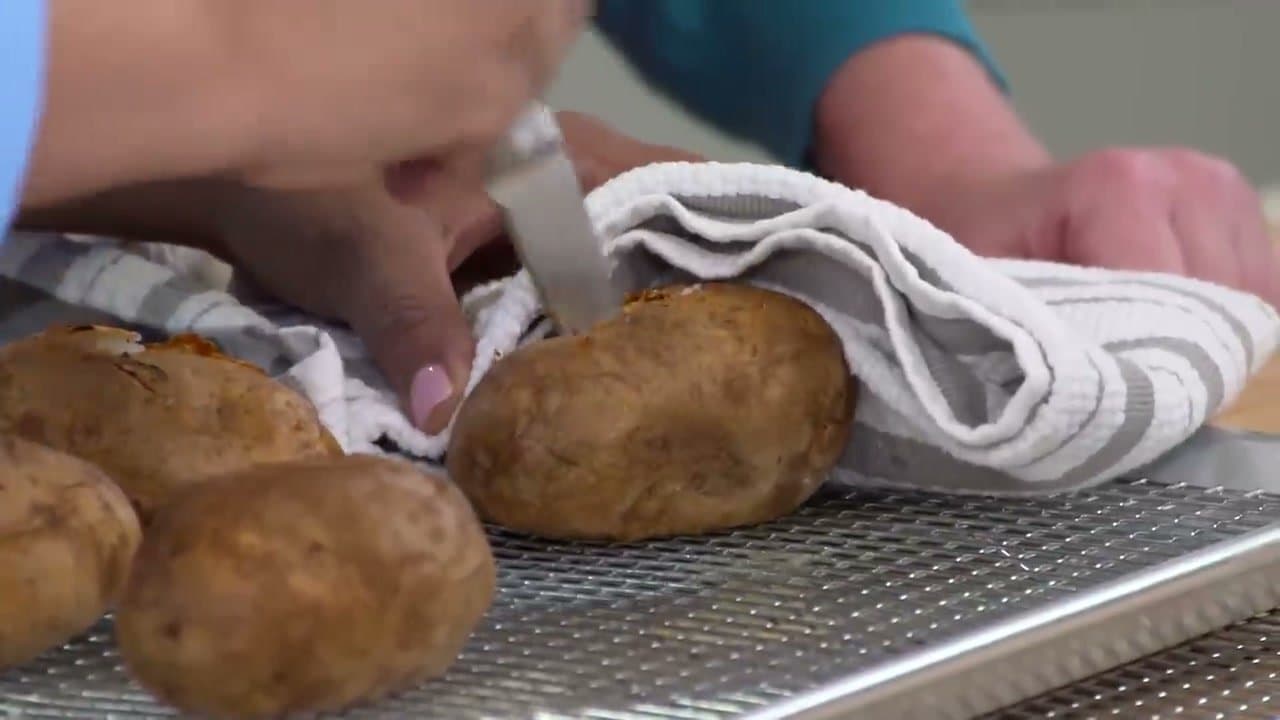
Pull the potatoes and cut into them right away. Don't rest them on the counter - the trapped steam needs to escape now or the interior compacts and turns dense. Cut an X in the top, squeeze the ends inward, and watch the steam pour out.

Top with butter, sour cream, chives, cheddar, bacon, or a quick goat cheese mix (smashed goat cheese, olive oil, parsley, shallots, and lemon zest).

Products used in this step

Sour Cream
Chives

Products Used

Russet PotatoesKosher SaltWire Cooling RackHalf-Sheet Baking PanInstant Read Meat ThermometerSour CreamChives
❖ The Recipe

How to Bake Potatoes in the Oven

American
Serves
Serves 4
Prep
5 min
Cook
1 hr
Total
1 hr 5 min

Ingredients

3 items
  • 4 largerusset potatoes
  • 2 tablespoonsolive oil
  • 2 teaspoonskosher salt

Nutrition

estimated · per servingEstimated from the ingredient list, not measured. Actual values vary by brand, preparation, and serving size. Not a substitute for measured nutrition data.
Calories
330kcal
Protein
7g
Fat
4g
Carbs
60g
Fiber
7g
Sodium
600mg

Method

  1. 1
    Poke Holes in Each Potato. Use a fork to poke six holes in each russet potato - about three on each side.
  2. 2
    Brine the Skin in Salt Water. Mix 1/2 cup water with 2 tablespoons of salt in a bowl.
  3. 3
    Set on a Wire Rack. Place the brined potatoes on a wire rack set inside a baking sheet.
  4. 4
    Bake at 450°F to 205°F Internal. Set the oven to 450°F.
  5. 5
    Brush with Oil. Pull the potatoes when they hit 205°F.
  6. 6
    Flash Finish for 10 Minutes. Return the oiled potatoes to the 450°F oven for another 10 minutes.
  7. 7
    Cut Open Immediately. Pull the potatoes and cut into them right away.

Your Guide

America's Test Kitchen

As an Amazon Associate we earn from qualifying purchases. Links on this page may be affiliate links - clicking them and buying doesn't change your price, but helps support ShowMeStepByStep.

Tags

Related Tutorials