To fold a fitted sheet so it actually holds its shape, turn it inside out, tuck two adjacent corners into each other, then nest the other two on top so all four stack together. Pull the elastic edges into a straight rectangle, smooth it flat, and fold into thirds.
Folding a fitted sheet is the laundry task everyone gives up on. The elastic edges fight you. There's no flat side to start from. And the instructions you find online usually make it sound like you need three hands.
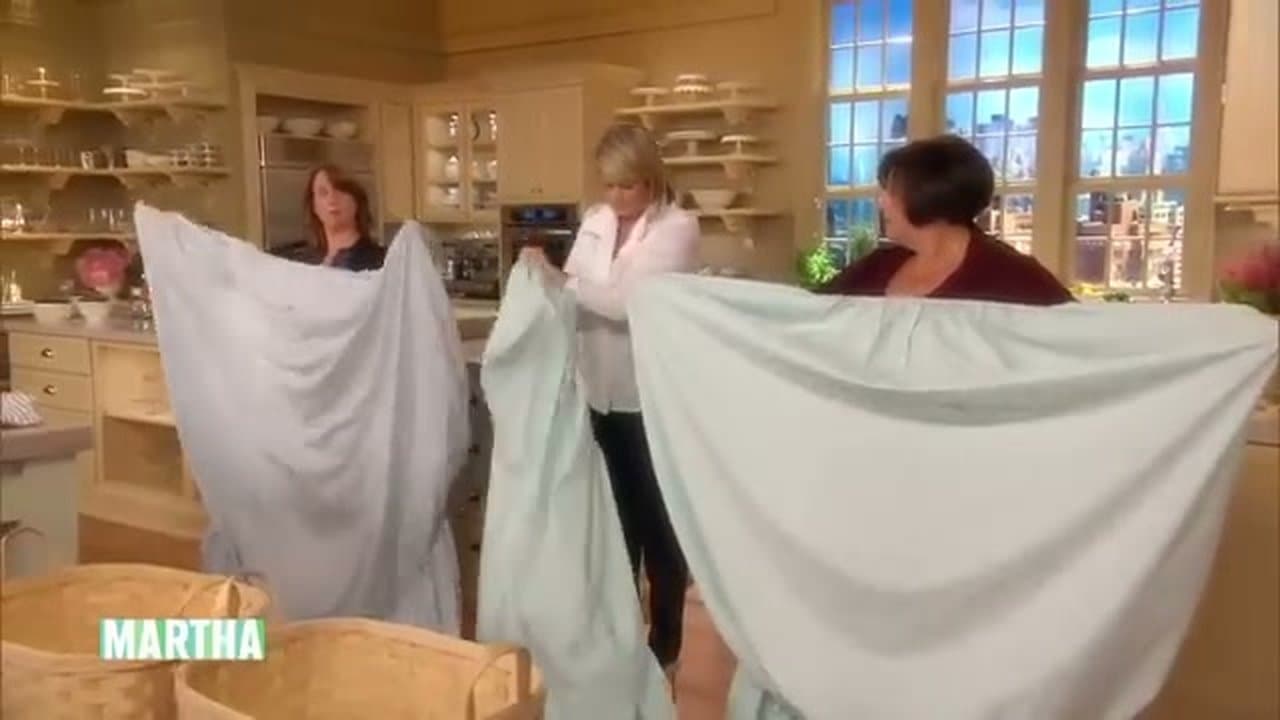
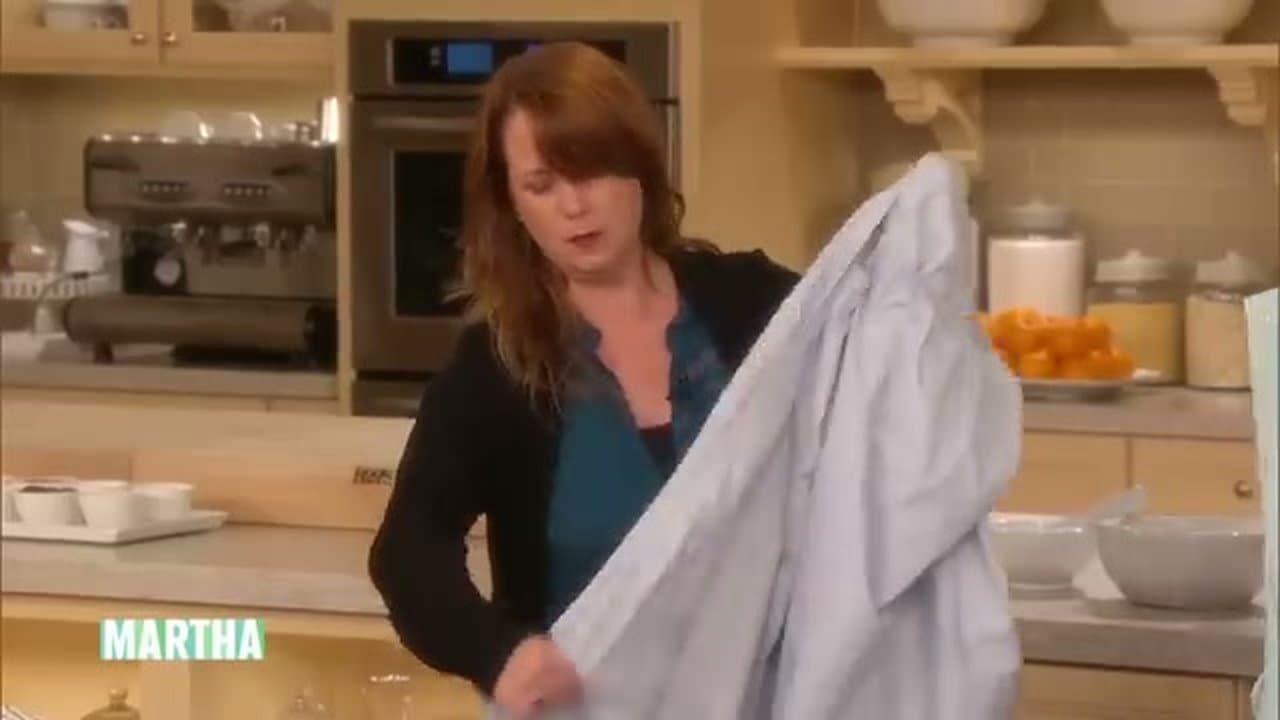
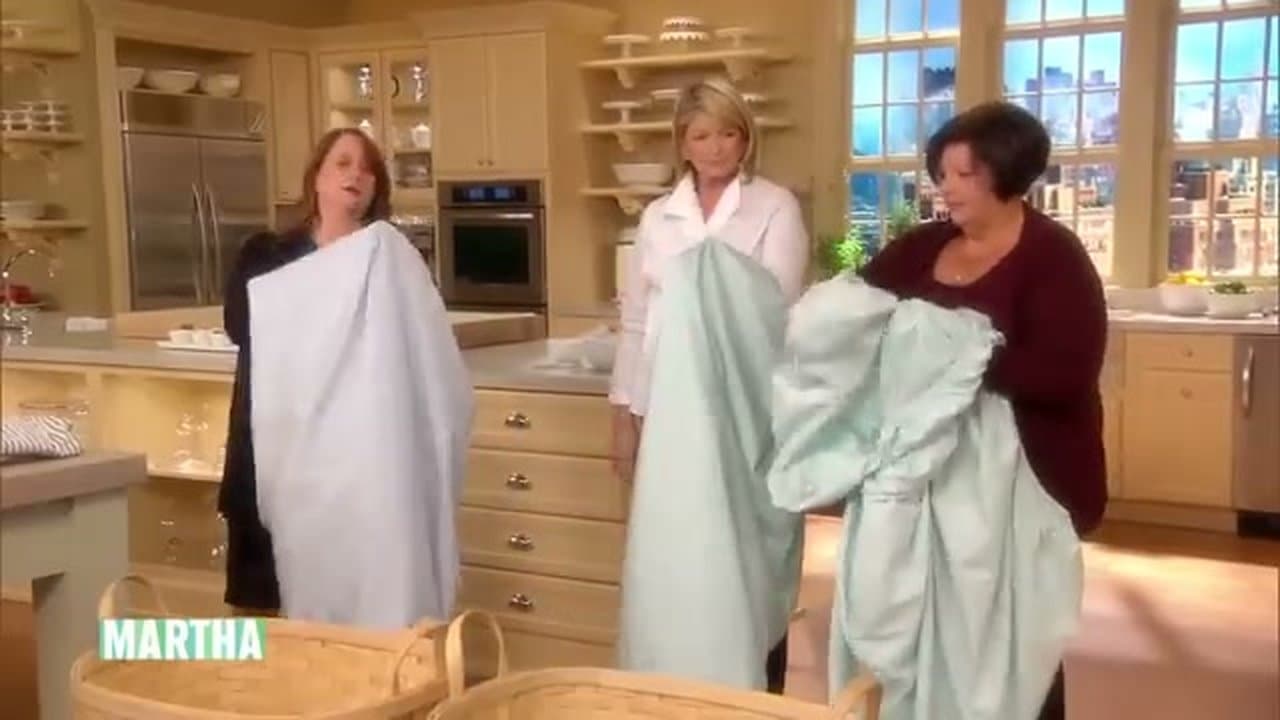
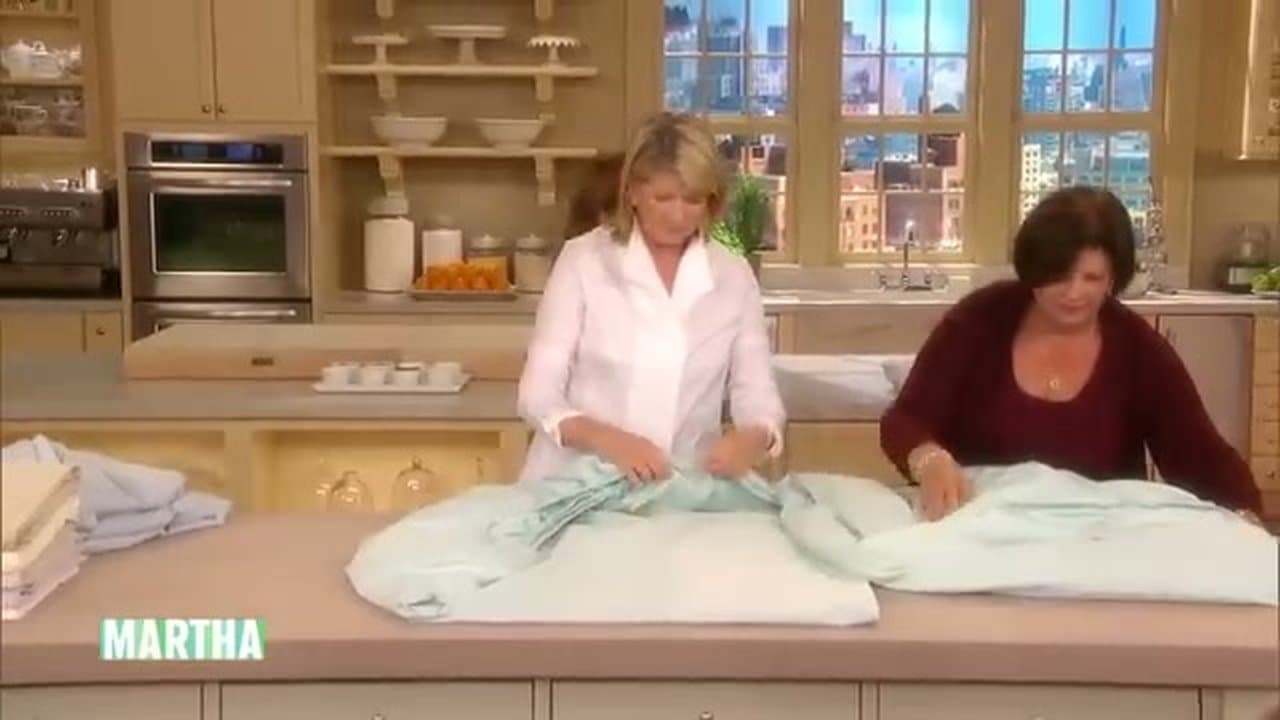
Martha Stewart's housekeeping expert Hosana demonstrates a method that actually works. The video is a comedy bit, which makes it funny to watch but also means the camera doesn't always hold on the technique - so the steps below break the method down in more detail than the video does.
The whole trick is nesting one corner inside another until all four corners are stacked on your left hand. Once they are, the sheet folds into a neat rectangle almost on its own. It takes a few tries to get the corner-nesting motion right. Stick with it. For other laundry-room wins, see how to wash a pillow and how to iron a dress shirt like a pro.
The whole fold in seven moves
Most people looking for a fitted sheet diagram want one thing: the shape of the motion, all in one place, before they pick up a sheet. Here it is. Read it through once, watch the video at the top of this page, then work the photo steps below where every move gets its own frame from the video.
- Turn the sheet inside out. Slide one hand into each of two corner pockets on the same short edge. Elastic seam faces you, sheet hangs down.
- Bring your right hand across to your left. Fold the right pocket over the left one so the right corner swallows the left corner. Two corners, one hand.
- Snap the sheet once and pull the seam straight. The elastic along the near edge should read as a line, not a wave.
- Walk your free hand down the hanging edge until your fingers hit the third pocket. Flip it up onto the stack the same way, inside out.
- Follow the elastic across to the fourth pocket and nest it on top. All four corners are now stacked in one hand.
- Lay it down on a bed or table. Pull the two elastic hems into a straight L, then square the rest with your palms until you have a rectangle.
- Fold in thirds the long way, then in half or thirds again until the bundle matches the depth of your shelf.
Moves 2 and 4 are where it goes wrong. Both are the same motion, and both depend on the corner going in inside out. If you flip a pocket on right-side out, the seams face opposite directions and the stack refuses to lie flat. When that happens, pull that one corner back off and re-flip it. You do not have to start over.
One physical detail the video moves past quickly: your holding hand never lets go. Every new corner lands on the same hand, on top of the ones already there. That hand ends up holding a four-layer wad, and that wad becomes the top-left corner of the finished rectangle.
How to fold fitted sheets neatly so the edges stay square
A folded fitted sheet can be small and still look like a bread roll. Getting a square, flat result comes down to four habits, and none of them are about strength.
Nest in the air, finish on a surface. The corner-nesting part needs gravity so the fabric hangs and the seams find each other. Everything after move 5 goes better on a bed or a dining table. Fabric held in the air keeps rolling into a curve. Fabric on a table stays where you put it.
Chase the elastic seam, not the fabric. Once the four pockets are stacked, the elastic hem forms two edges of your rectangle. Run a flat palm along each of those hems and push the gathered part out toward the corners. Elastic wants to bunch. Flatten it before the first fold or it turns into a ridge buried in the middle of the stack.
Fold in thirds, not halves. Halves leave you with a square, and a square does not stack with anything else in the closet. Thirds give you a long rectangle roughly the footprint of a folded flat sheet, which is what makes a stack look tidy from the front.
Fold to the shelf, not to a rule. Measure the depth of your linen shelf once. Fold every sheet in the house to that depth and the whole closet lines up on the front edge. This is the same idea behind folding clothes the KonMari way, where the fold size is set by the drawer rather than by the garment.
Folding a fitted sheet by yourself
You never need a second person. What you need is height. Hold the sheet high enough that the bottom edge clears the floor, because a corner dragging on the carpet is what drags the whole seam crooked. Short on ceiling? Stand on the far side of the bed and let the sheet drape over the mattress while you work the corners. The mattress carries the weight and your hands only manage the pockets.
If the sheet is heavy enough to fight you - king, flannel, anything still damp - do moves 1 through 3 standing, then lay the half-nested sheet on the bed and finish moves 4 and 5 flat. The nest works the same lying down. It is slower and it comes out squarer.
Variations by sheet size and type
Queen and king fitted sheets. Same exact method, just more fabric to manage. Lay the sheet flat on a bed or large table to make the corner-nesting easier (you don't need to do the entire fold standing up). The four-corner stack at the end will be bulkier; just press it flatter as you fold into thirds. Allow an extra 30 seconds compared to a twin sheet.
Twin and twin XL fitted sheets. The easiest size to fold. You can do the whole thing standing with the sheet held in front of you. Twin XL (common in college dorms) is the same width as twin but 5 inches longer, so the final folded rectangle is slightly taller - everything else identical.
California king. Four inches narrower than a standard king and four inches longer, which sounds trivial and is not. The extra length means the fourth corner sits further away than your arm span, so you will be walking your hand along the elastic instead of reaching for it. Do this one on a bed. Fold the finished rectangle in quarters rather than thirds or it hangs off the front of most shelves.
Split king and adjustable-base sheets. A split king set is two twin XL fitted sheets, so fold them as twin XLs and store them as a pair. Sheets cut for adjustable bases often have extra-deep pockets plus a wrap-around skirt. Treat them like deep-pocket sheets below.
Deep-pocket fitted sheets (for thick mattresses or toppers). The elastic is loose enough that nesting the corners feels sloppier, but the method still works. The first corner-flip is the trickiest because the deep pocket has more slack; pin the seam straight with your thumb when you nest the second corner so the edge does not twist. Deep pockets also carry more fabric per corner, so the four-corner stack is thick. Press it with your palm before the first third-fold.
Sheets with elastic all the way around vs elastic at the corners only. Worth knowing which one you own, because they behave differently. All-around elastic pulls the whole hem into a gathered ring, so the two edges of your rectangle will want to curl inward. Stretch each hem out flat and hold it for a second before you fold; the elastic relaxes. Corner-only elastic gives you two straight fabric edges between the pockets, which makes the rectangle come out square almost on its own. Corner-only is the easier sheet to fold and the harder one to keep on a mattress.
Crib and toddler sheets. Small enough to fold like a regular flat sheet if you tuck the elastic in first. Lay flat, push all four elastic corners toward the center, then fold the resulting square in half twice. Skip the corner-nesting entirely.
Bunk, RV, and camper sheets. Odd sizes with shallow pockets and short elastic. The nesting method works, but the pockets are so shallow that they pop back off each other. Hold the stack tighter and get it onto a flat surface fast.
Jersey, flannel, and percale. Jersey is knit, so it stretches on the bias and the rectangle drifts out of square while you fold it. Square it up again right before the last fold. Flannel is thick and grips itself, which makes nesting easy and the finished bundle fat. Percale is crisp and holds a crease, so it gives the sharpest rectangle of the three. Sateen sits between percale and satin.
Satin, silk, or sateen fitted sheets. Slippery fabric resists the nesting motion. Work on a slightly textured surface (a folded blanket on top of a bed) so the fabric does not slide off your hand mid-flip. Otherwise the method is the same.
How to fold a flat sheet
The flat sheet is the top sheet, the one with no elastic anywhere. It is the easy half of the set and it takes about twenty seconds once you stop treating it like a bedspread.
- Hold it by the two corners of the wide hem. That hem is the top edge, the part that folds back over the blanket, and it is usually two to four inches deep. Keeping it aligned is what makes the finished stack look sharp.
- Bring those two corners together and give the sheet a shake so the long edges hang free.
- Fold it in half again the same way, then lay it on the bed.
- Smooth from the center out to push the air and the ripples off the edges.
- Fold in thirds the short way to match the width of your folded fitted sheet.
The one thing worth being fussy about is that wide hem. If it lands crooked in step 1, every fold after it is crooked, and no amount of smoothing fixes it. Line the hem up first, then fold.
Flat sheets get pulled out of the dryer in a tangle more often than fitted ones because they are the biggest single piece in the load. Shake each one out before it goes in the basket. The same rule applies to folding towels and to folding a t-shirt: fold it while it still has the warmth in it and the creases fall out on their own.
How to fold a whole set of bed sheets
Quick vocabulary, because the search terms use both: the bottom sheet and the fitted sheet are the same thing. The bottom sheet is the one with elastic that goes on the mattress. The top sheet is the flat one. A full set is bottom sheet, top sheet, and two pillowcases.
Fold the set in this order and the stack builds itself:
- Pillowcases first. Fold each one in half lengthwise, then in thirds. Set one aside unfolded; you need it in a minute.
- Flat sheet second. Fold it to the width you want the whole bundle to be. This piece sets the size for everything else.
- Fitted sheet third, folded to match the flat sheet.
- Stack them with the flat sheet on the bottom, fitted sheet on top of it, folded pillowcases on top of that.
- Slide the stack into the spare pillowcase and fold the open end under.
That last move is the one that changes a linen closet. The pillowcase holds the set together, so nothing unfolds under its own weight and you never dig through a shelf hunting for the matching case. Every bundle on the shelf is one complete set of sheets, and they stack like books.
If you keep more than one size in the house, write the size on the hem tag of the pillowcase you use as the wrapper with a laundry marker. Queen and king bundles look identical on a shelf and feel identical through the fabric.
When the fold still comes out lumpy
Four failures cover almost every bad result.
The stack will not lie flat. One corner went on right-side out. Peel the top pockets off one at a time until you find the one whose seam faces the wrong way, re-flip it, and rebuild from there.
The rectangle keeps coming out as a trapezoid. The elastic hem is still gathered. Stretch both hems flat with your palms and pull the far corner out square before the first fold.
There is a hard ridge through the middle. That is the four-corner stack, and it belongs at one end of the rectangle, not in the center. Position it in a corner and fold away from it.
It looked fine and unraveled on the shelf. Too few folds, or the sheet went in warm. A warm sheet keeps releasing steam and relaxing. Let it cool for five minutes on the bed before it goes in the closet.
Common questions about folding fitted sheets
The questions we get most often about getting fitted sheets to fold flat without giving up and shoving them in the linen closet.
Why is folding a fitted sheet so hard?
The elastic-hemmed corners are what make the sheet stay on the mattress, and they're what make folding awkward. Every other piece of laundry has flat edges to align; a fitted sheet has four pocketed corners that pull the rest of the fabric in unpredictable directions. Nothing you do to the flat middle helps while those corners are loose, which is why most people end up wrestling the sheet instead of folding it. The corner-nesting method works because it converts those four 3D corners into one stacked corner before you start folding the flat parts.
How do I fold a king-size fitted sheet by myself?
Same nested-corners method, just lay the sheet on a bed or table partway through. After step 3 of the technique, set the partially-nested sheet flat on a bed, then complete the corner-flips while it's lying down. You're not strong-arming a giant sheet through the air; you're working it into shape on a surface.
Should I iron my fitted sheets?
Almost never. The elastic edges cannot take the heat, and the cotton-elastic blend at the seams will shrink unevenly. If you need crease-free sheets, iron only the flat sections (top and bottom faces) with the iron on cotton setting, and avoid the elastic corners entirely. Most fitted sheets release wrinkles within a few hours on the bed. Put them on damp from the dryer and skip the iron.
How do I store folded fitted sheets so they stay neat?
Bundle each set inside one of its own pillowcases, as described in the sheet-set section above. The pillowcase stops the fitted sheet unfolding under its own weight and keeps the matching pieces together. Store bundles on their side, spine out, so you can read the stack instead of excavating it.
Why has the elastic on my fitted sheet stretched out?
Heat damage from a too-hot dryer is the usual cause. Polyester elastic loses its memory at high temperatures and never quite recovers. Wash fitted sheets in cold or warm water and tumble dry low, or hang them. A dryer that runs hotter than its setting is often a venting problem rather than a thermostat problem, so it is worth learning how to clean a dryer vent if your sheets are coming out scorching. Once the elastic is shot, a new sheet costs less than the hour it takes to sew fresh elastic into the corner pockets.
Which two corners do you start with, adjacent or opposite?
Start with two adjacent corners, the ones on the same short edge of the sheet. Turn the sheet inside out, slip your hands into those two corner pockets, then bring the right corner over the left and nest it inside. Opposite corners won't line up the elastic seam, and that misalignment is what makes the fold collapse into a ball.
How long should a folded fitted sheet last on the shelf?
Indefinitely, if it went in cool and folded in thirds. Sheets that spring open after a week were folded warm or folded in halves. Cotton holds a crease better than jersey, so a jersey sheet will always look a little softer on the shelf no matter how square you got it.