How Much Social Security Will I Get?

Also in:Adulting

By ShowMeStepByStepPublished

Based on a video by Devin Carroll, CFP®.

How much Social Security will I get? If you are within 10 years of retirement, that question probably keeps you up at night. The SSA gives you an estimate inside your my Social Security account, but the fine print says that number assumes you keep earning the same paycheck through retirement age. If you plan to retire early, drop to part-time, or pick up a higher-paying job in your last few years, the SSA number can be off by hundreds of dollars a month.

This walkthrough is built around a clear three-step breakdown by CFP Devin Carroll. You will calculate your own Average Indexed Monthly Earnings (AIME), apply it to the bend-point formula to find your Primary Insurance Amount (PIA), and then adjust for the age you actually plan to file. Once you have done it once, you can rerun the numbers under any scenario - retire at 62, work until 67, stop at 70 - and see exactly what changes.

If you are stacking your retirement income picture, also check our walkthroughs on opening a Roth IRA on Fidelity, when you can actually afford to retire, and how to calculate your RMD. Social Security is one leg of a three-leg stool. The other two matter just as much.

Disclaimer: This is general educational content, not personal financial advice. Bend points, indexing factors, and full retirement ages change. Before you file, check the current numbers on SSA.gov or talk to a CFP who knows your full income picture.

Step-by-Step Guide

1

Step 1: Why You Cannot Just Trust the SSA Estimate

0:52

Step 1: Step 1: Why You Cannot Just Trust the SSA Estimate

How much Social Security will you actually get? The SSA gives you a number inside your my Social Security account, but read the disclaimer right under it. It says, in plain English, we assume your earnings will continue at the same level until your retirement age, and if they are different your benefit will not match the estimate. Watch the intro at 0:52. If you plan to retire early, drop to part-time, take a sabbatical, or close out your career with a big salary jump, the SSA estimate is built on the wrong income assumption. Knowing how to redo the math yourself takes about twenty minutes and gives you the real number under any scenario.

Tip

The whole calculation is just three steps: find your AIME, run it through the bend-point formula to get your PIA, then adjust for filing age. We will walk through each one.
2

Step 2: Set Up a Six-Column Spreadsheet

4:00
Step 2: Step 2: Set Up a Six-Column Spreadsheet

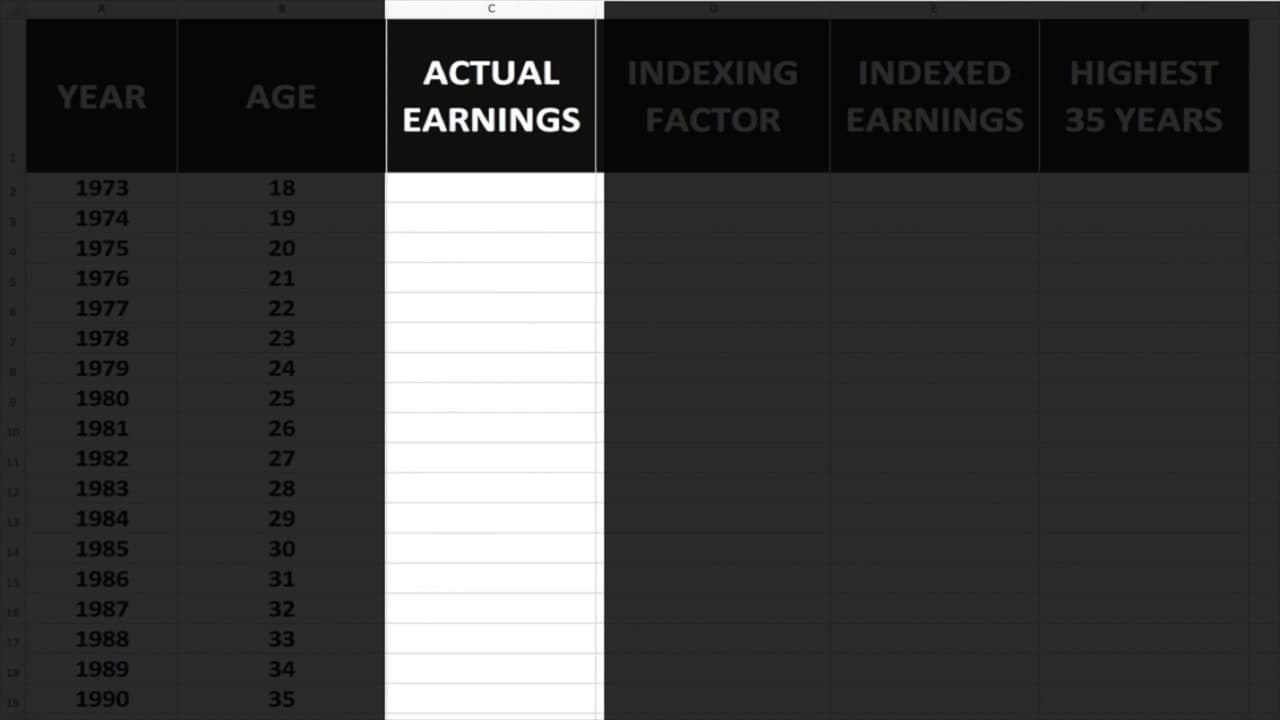
Open Excel, Google Sheets, or just a paper notepad. You need six columns across the top: Year, Age, Actual Earnings, Indexing Factor, Indexed Earnings, and Highest 35 Years. Watch the setup at 2:55. Putting Year and Age side by side feels redundant, but you will thank yourself in Step 4 when you have to look up an age-specific indexing factor for every row. Leave plenty of room. If you started working at 18 and you are 65 now, that is 47 rows to fill in.

Tip

If you are still working and have not hit 35 years, leave the future rows blank for now. We come back to them at the end of Step 5 with an estimate.

3

Step 3: Pull Your Taxed Earnings History from SSA.gov

3:40
Step 3: Step 3: Pull Your Taxed Earnings History from SSA.gov

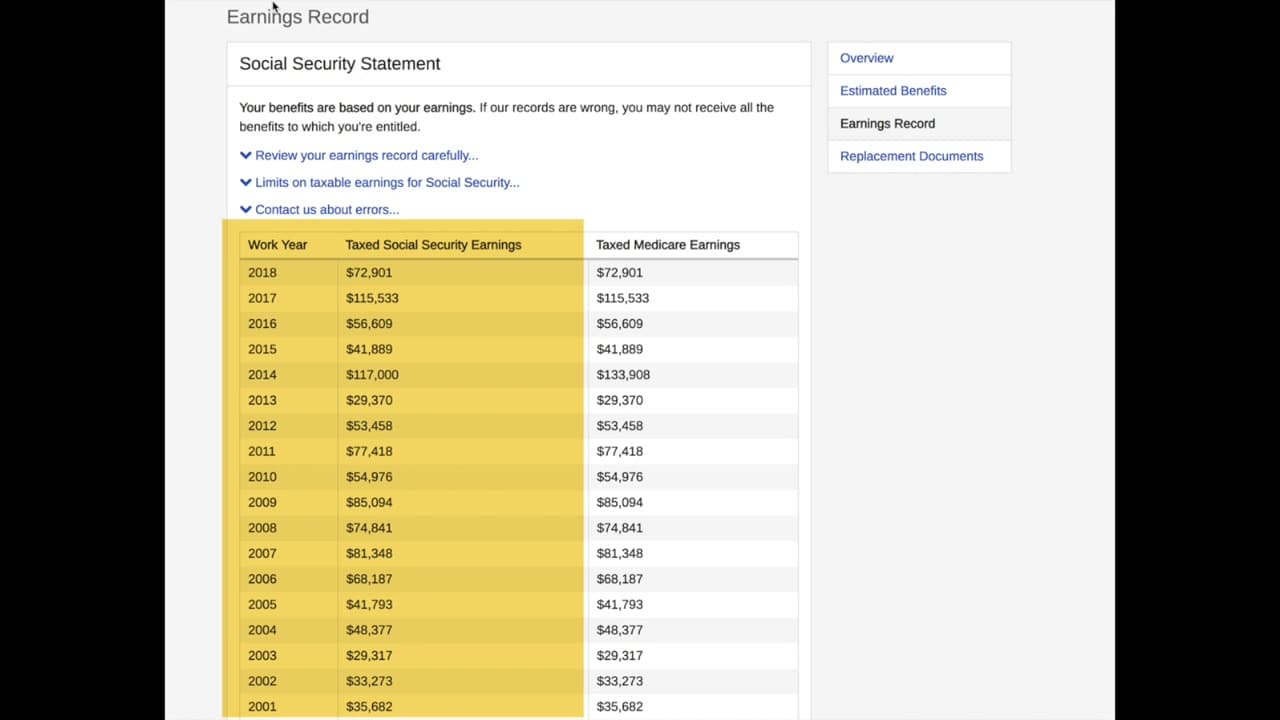
Log into your my Social Security account at ssa.gov/myaccount and click View Earnings Record. Watch the walkthrough at 3:40. You want the column labeled Taxed Social Security Earnings, not Taxed Medicare Earnings. Copy each year into your spreadsheet. Do not skip any years, even the zero years - missed years count as zeros in the average, and the formula uses your highest 35, so missing years matter. If you do not have an online account yet, set one up at the same URL. It takes about ten minutes and a couple of identity-verification questions.

Tip

If something looks wrong in your earnings record (a missing year of work, the wrong dollar amount), fix it now. The SSA will only correct earnings up to three years, three months, and fifteen days after the year in question - older errors get harder to prove every year.

4

Step 4: Get Your Age-Specific Indexing Factors

5:00
Step 4: Step 4: Get Your Age-Specific Indexing Factors

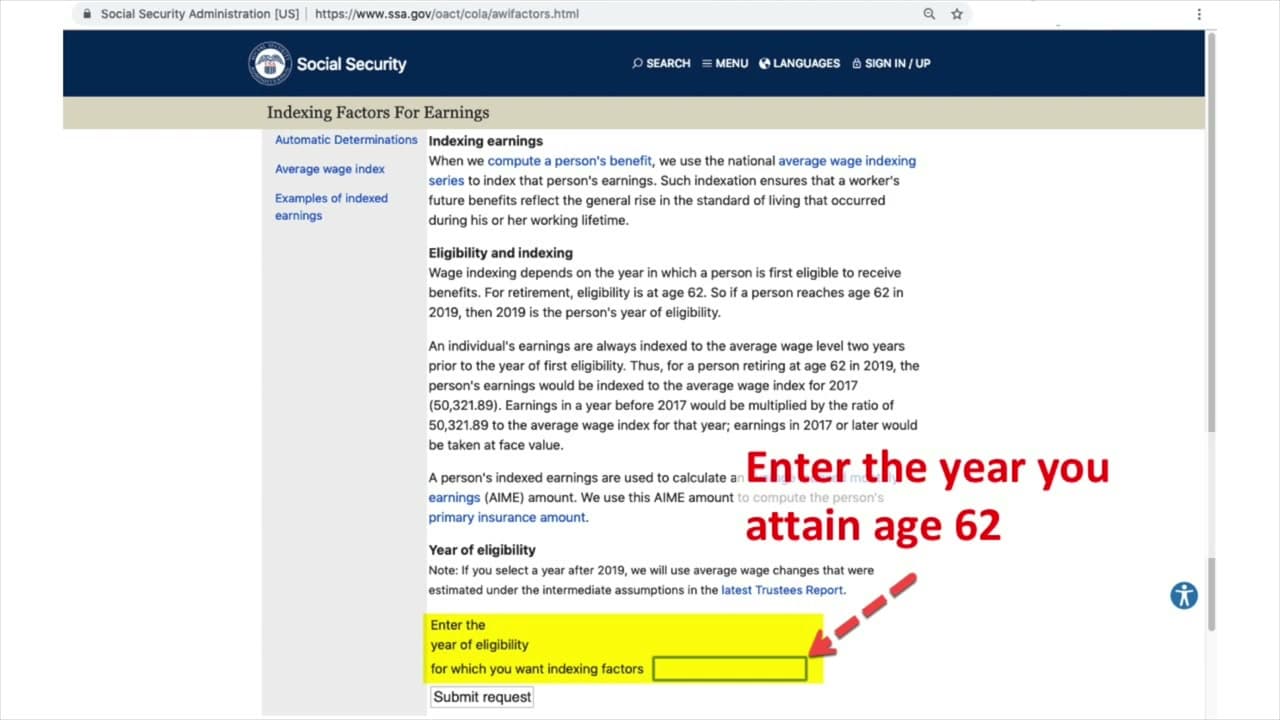
SSA adjusts your old earnings for wage inflation, but only through the year you turn 60. Anything you earned at 60 or later goes in at face value. Visit the indexing factors page at ssa.gov/oact/cola/awifactors.html. Watch this part at 4:50. At the bottom of that page, enter the year you turn (or turned) 62. The SSA spits back a list of factors, one per year. Multiply each year's Actual Earnings by its Indexing Factor and write the result in the Indexed Earnings column. Years where the factor is 1.0 (age 60 onward) come across unchanged.

Tip

The SSA generates indexing factors based on your year of first eligibility, which is age 62 even if you do not plan to claim that early. Always put your year-you-turn-62 in the box, no matter when you actually file.

5

Step 5: Find Your Top 35 Years and Divide by 420

6:55
Step 5: Step 5: Find Your Top 35 Years and Divide by 420

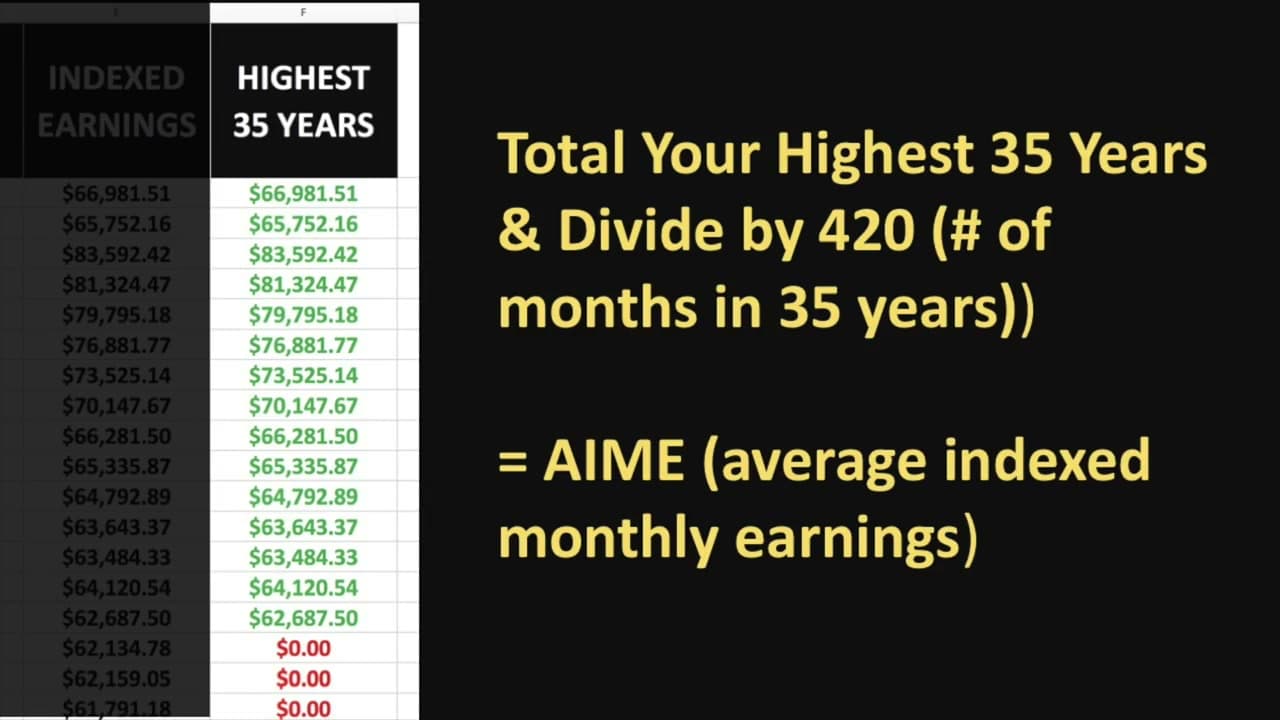
Sort your Indexed Earnings column from largest to smallest and copy the top 35 values into the Highest 35 Years column. Watch the wrap-up at 6:20. If you do not have 35 working years, the missing slots count as zeros and they drag your average down hard, so plan to keep working if you can. Add up all 35 numbers, then divide by 420 (the number of months in 35 years). The result is your Average Indexed Monthly Earnings, your AIME. Devin's example AIME comes out to $5,726, but yours will be different. This is the hardest step in the whole process. The next two are quick.

Tip

Stuck for a year you are short? Try the calculation twice - once with zeros for the missing years, once with a realistic estimate of future earnings. The gap between the two numbers tells you what each extra working year is worth.

6

Step 6: Run Your AIME Through the Bend-Point Formula

8:00
Step 6: Step 6: Run Your AIME Through the Bend-Point Formula

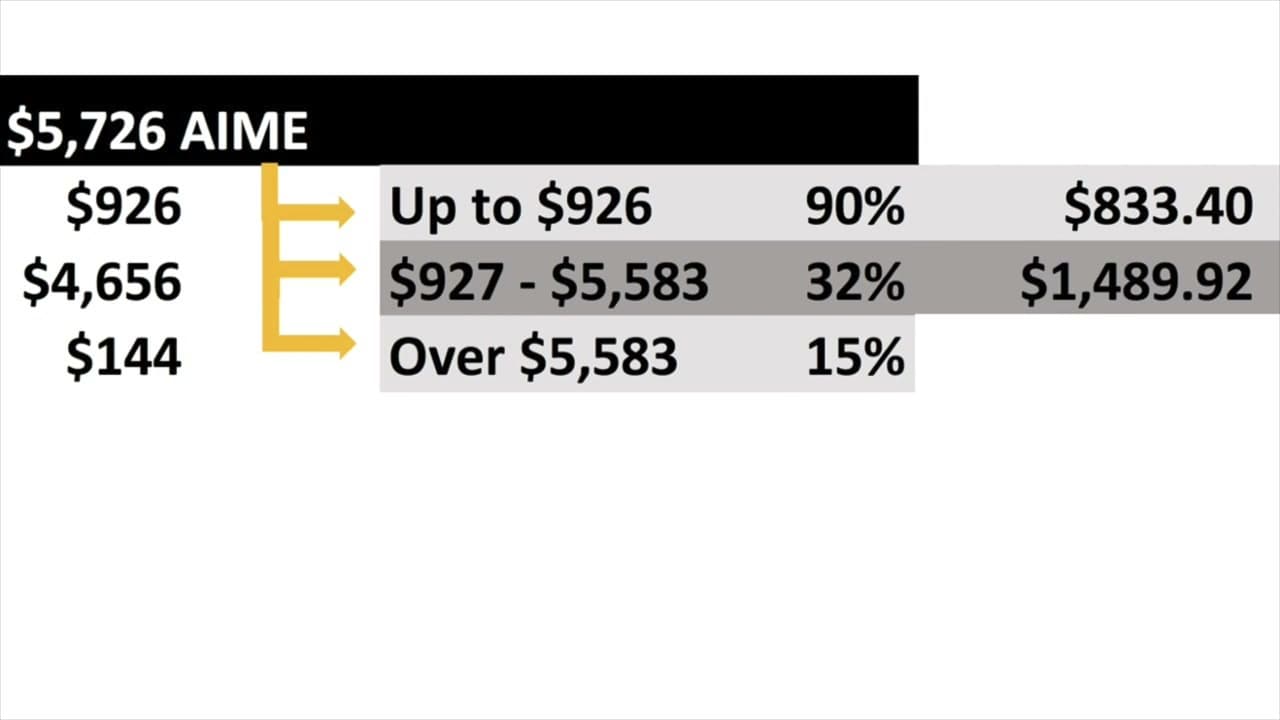
This is where your AIME becomes a benefit amount. The formula has three tiers and two bend points. For the 2019 bend points Devin uses in the example ($926 and $5,583): the first $926 of AIME counts at 90 percent, the chunk from $927 to $5,583 counts at 32 percent, and anything above $5,583 counts at 15 percent. Watch the worked example at 8:00. Run his $5,726 AIME through it: $926 x 90% = $833, $4,657 x 32% = $1,490, $143 x 15% = $21. Sum those and you get a Primary Insurance Amount (PIA) of about $2,344 per month. That is your Full Retirement Age benefit. You have to use the bend points for the year you turn 62 - they update every January, and the current numbers live at ssa.gov/oact/cola/bendpoints.html.

Tip

The 90/32/15 percentages never change - only the bend-point dollar amounts move with wage inflation. That progressive structure is why a lower earner gets back a higher percentage of their pre-retirement income than a high earner does.

7

Step 7: If You Are Not 62 Yet, Project the Bend Points Forward

9:20
Step 7: Step 7: If You Are Not 62 Yet, Project the Bend Points Forward

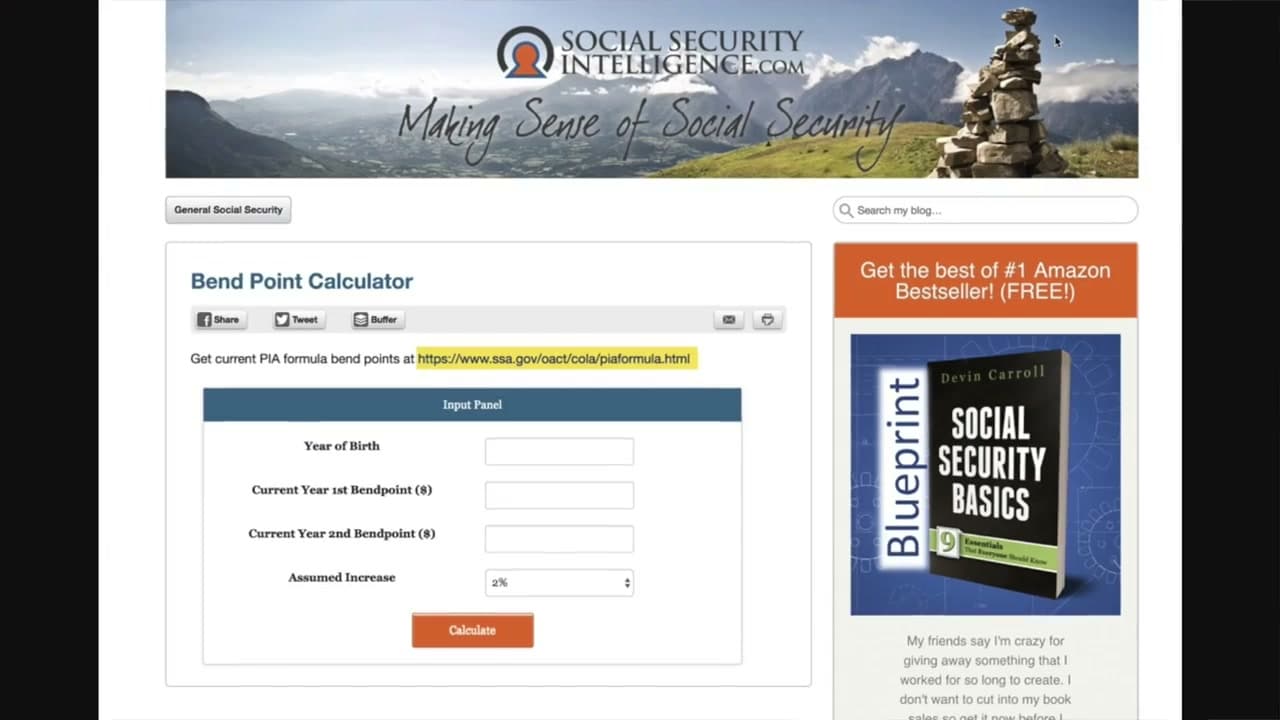
The bend points in Step 6 are the ones for the year you turn 62. If 62 is still a few years out, you have to estimate where the bend points will be by then. Watch the projection at 9:20. Devin built a free bend-point calculator at socialsecurityintelligence.com/bend-point-calculator. Enter your year of birth, the current year's first and second bend points (pull them from the SSA page), and an inflation assumption. The SSA Trustees expect about 4 percent average wage growth per year; pick 2, 3, or 4 percent based on how conservative you want to be. The calculator returns the projected bend points for your eligibility year, and you plug those into the formula in Step 6 the same way.

Tip

Use the PIAA formula bend points, not the family benefit formula. The SSA page lists both side by side, and they are very different numbers - mixing them up gives you a benefit estimate that is way off.

8

Step 8: Adjust for Filing Age - 62 to 70

11:30
Step 8: Step 8: Adjust for Filing Age - 62 to 70

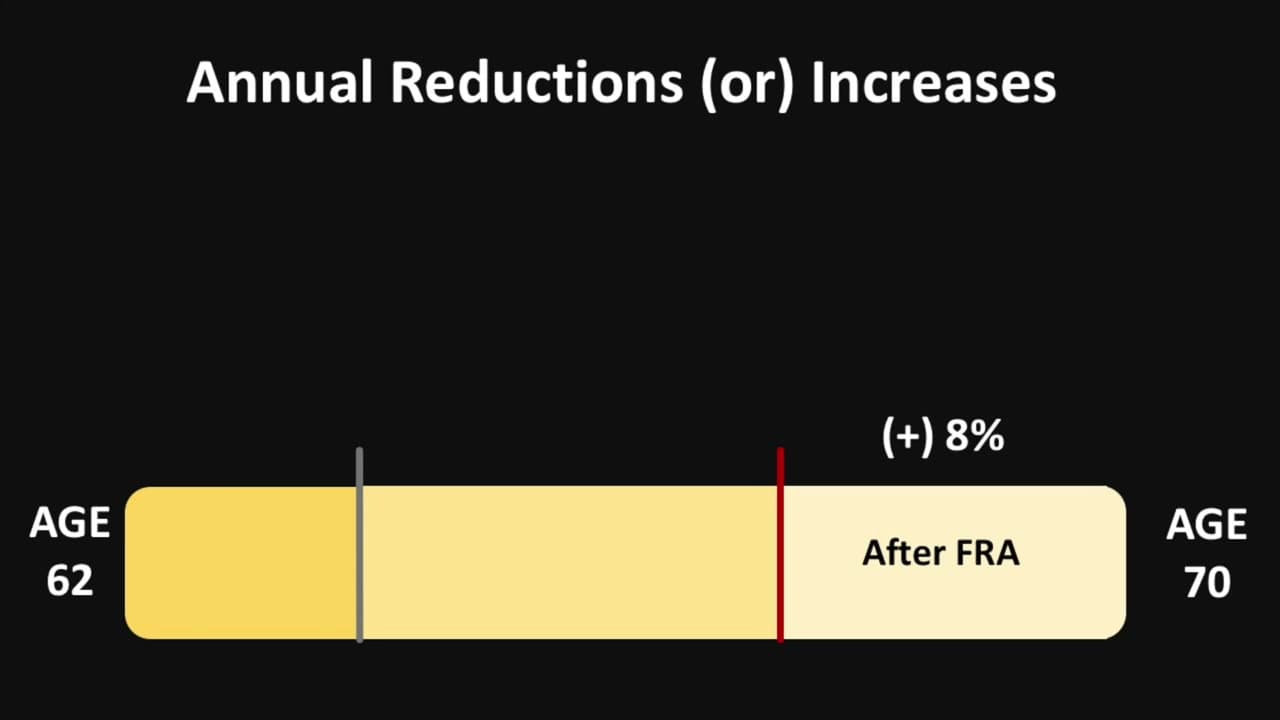
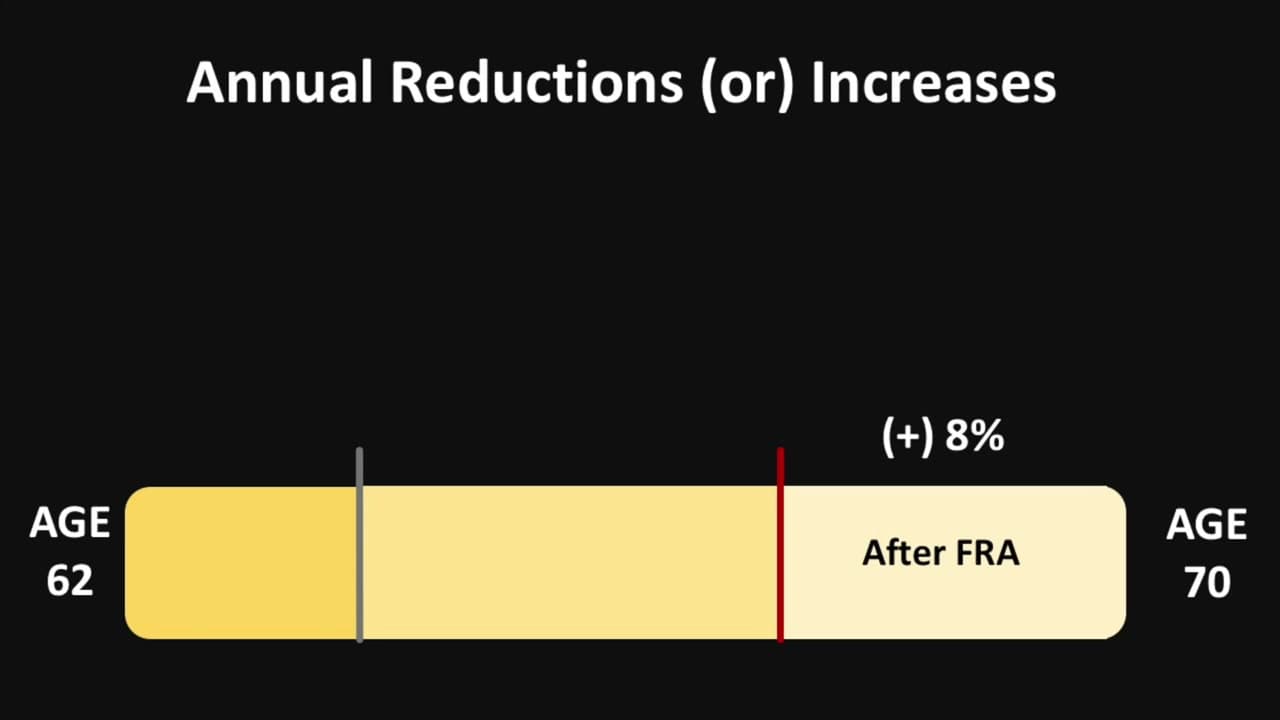
Your PIA is the benefit you get at your Full Retirement Age (66 to 67 depending on birth year). If you file earlier, the SSA cuts your check. If you file later, they grow it. Watch the breakdown at 11:30. File any time after FRA and your benefit grows 8 percent per year, up to age 70 (about 0.667% per month of delay). File in the 36-month window right before FRA and your benefit drops about 6.67% per year (0.556% per month). File more than 36 months before FRA - so age 62 for most people - and the cut accelerates to 5% per year on top of the 6.67%. The difference between filing at 62 and 70 is roughly 77% more income for life if you wait. Plug a few filing ages into your spreadsheet and see what each one is worth.

Tip

The right filing age is not always 70. If you have a shortened life expectancy, a lower-earning spouse who needs the survivor benefit, or you simply cannot afford to bridge the gap to 70 without dipping into IRAs at a bad rate, claiming earlier can still be the right move. Run the math both ways before you file.

Products Used

Your Guide

Devin Carroll, CFP®

As an Amazon Associate we earn from qualifying purchases. Links on this page may be affiliate links - clicking them and buying doesn't change your price, but helps support ShowMeStepByStep.

Tags

Test your knowledge

Did the lesson stick? Find out in 2 minutes.

5 quick questions covering what you just read. No signup, no score saved — just a gut check.

Quick reference

Key takeaways from How Much Social Security Will I Get?

5 questions, answers, and one-line explanations. Tap to expand.

  1. 1.Why might the SSA's online estimate be wrong?

    Answer: Assumes flat earnings

    The SSA assumes you keep earning the same paycheck until retirement age. Early retirement or salary jumps throw it off by hundreds a month.

  2. 2.What does AIME stand for?

    Answer: Average Indexed Monthly Earnings

    Average Indexed Monthly Earnings. Sum of your top 35 indexed years divided by 420 (months in 35 years).

  3. 3.Earnings are indexed for wage inflation up to what age?

    Answer: Age 60

    Through age 60. Anything you earn at 60 or later goes in at face value. The factors come from the year you turn 62.

  4. 4.How many years are averaged in the AIME calculation?

    Answer: Top 35 years

    Your highest 35 years. Missing years count as zeros and drag the average down hard - one more working year can be worth real money.

  5. 5.What's the delayed retirement credit per year past FRA?

    Answer: 8 percent

    8 percent per year up to age 70 (0.667% per month). The right filing age isn't always 70 though - health and spouse benefits factor in.

What's next

Related collections

Curated theme pages that include this tutorial.

Weekly Digest

Liked this investing tutorial?

Pick the categories you want to hear about. Weekly digest of new step-by-step tutorials. No spam, easy unsubscribe.

Send me tutorials about

We only email about new tutorials. Easy unsubscribe anytime.