How to Calculate Your RMD - 7-Step Required Minimum Distribution Guide

InvestingMedium8:027 stepsBrowse more →

By ShowMeStepByStepPublished Updated

Based on a video by Matt Frankel, CFP®.

How to calculate your Required Minimum Distribution: if you have any tax-deferred retirement account (traditional IRA, 401(k), 403(b), 457(b), or Thrift Savings Plan), the IRS makes you start withdrawing a minimum amount once you hit age 73. Don't take it on time and the penalty starts at 25%. This guide walks through the exact calculation in 7 steps.

Matt Frankel is a CERTIFIED FINANCIAL PLANNER (CFP) and Motley Fool contributor. This tutorial follows his slide deck for the 2025 RMD calculation, updated to reflect the SECURE Act 2.0 age changes. The math is straightforward (your balance divided by a number from an IRS table), but the rules around aggregation, deadlines, and Roth exemptions are where most retirees stumble.

The single most important thing to know: this is general educational content, not personal financial advice. Verify your specific RMD with the IRS Publication 590-B Uniform Lifetime Table at IRS.gov, or with a Certified Financial Planner or tax professional. The penalty for getting this wrong is real money. For other retirement-finance basics, see how to open a Roth IRA on Fidelity and how to file taxes online with TurboTax.

Step-by-Step Guide

1

Step 1: Confirm Whether You Have to Take an RMD This Year

0:45
Step 1: Step 1: Confirm Whether You Have to Take an RMD This Year

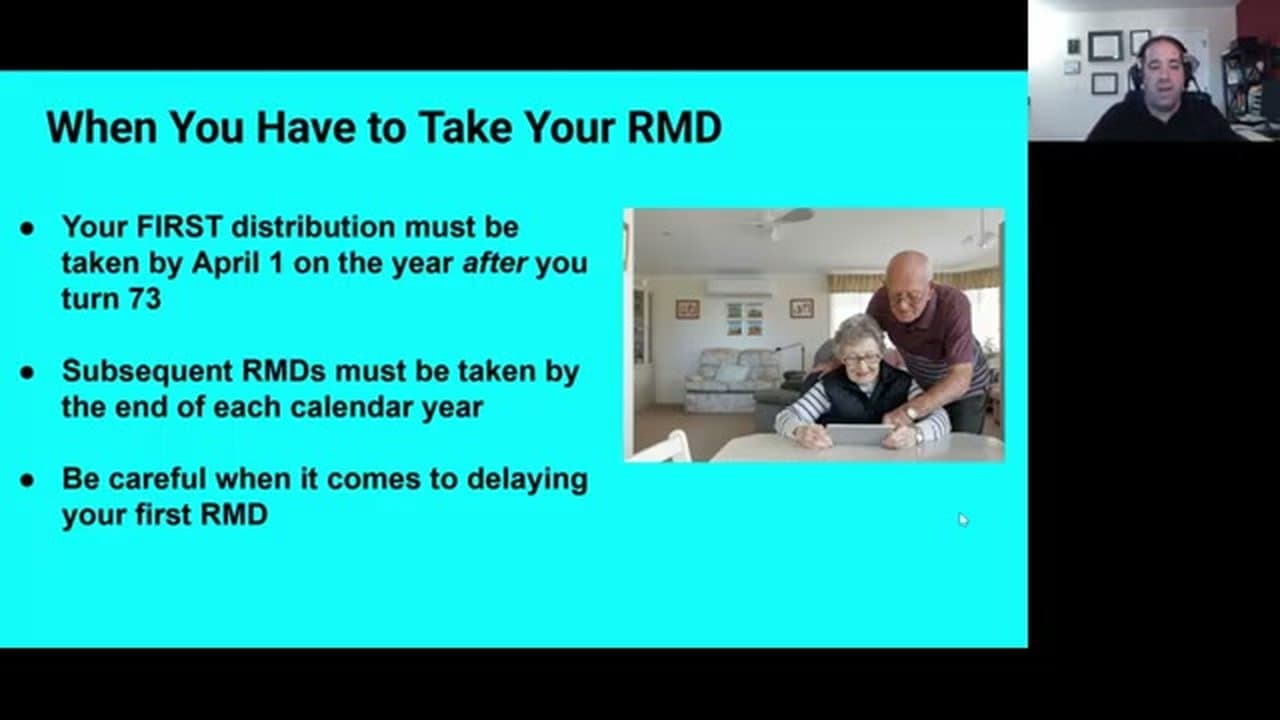
The RMD age changed under the SECURE Act 2.0. It used to be 70 1/2 for decades, but starting in 2023 the age moved to 73. So if you're 71 or 72, you do NOT have to take an RMD yet. If you turn 73 in 2025, your FIRST required minimum distribution must be taken by April 1 of the YEAR AFTER you turn 73 - that's April 1, 2026 for someone turning 73 in 2025.

Every RMD after the first must be taken by December 31 of the year you owe it. So your second RMD (the one for the year you turn 74) is due by December 31 of that same year - no April 1 grace period for subsequent RMDs.

Tip

If you're still working at age 73 and you have a 401(k) at your current employer, you may be exempt from RMDs on that specific 401(k) until you retire (the "still working" exception). It does not apply to IRAs or to 401(k)s from prior employers.
2

Step 2: Think Twice Before Delaying Your First RMD

1:40
Step 2: Step 2: Think Twice Before Delaying Your First RMD

That April 1 grace period for the first RMD looks attractive, but it creates a tax trap. If you delay your first RMD to April 1 of the year AFTER you turn 73, you end up taking TWO RMDs in that same calendar year - the delayed first one plus the regular second one due by December 31.

Two RMDs in one year doubles your taxable income from retirement withdrawals. That can push you into a higher federal tax bracket, increase the taxable portion of your Social Security benefits, and trigger Medicare IRMAA surcharges that raise your Part B and Part D premiums for two years.

For most retirees, taking the first RMD in the same calendar year you turn 73 (rather than waiting until April 1 of the next year) is the simpler and less expensive tax outcome.

Tip

If you must delay your first RMD - usually because you turned 73 in December and can't move money before year-end - work with a CFP or tax professional to estimate the bracket impact BEFORE you do it.

3

Step 3: Identify Which Accounts Require an RMD

2:25
Step 3: Step 3: Identify Which Accounts Require an RMD

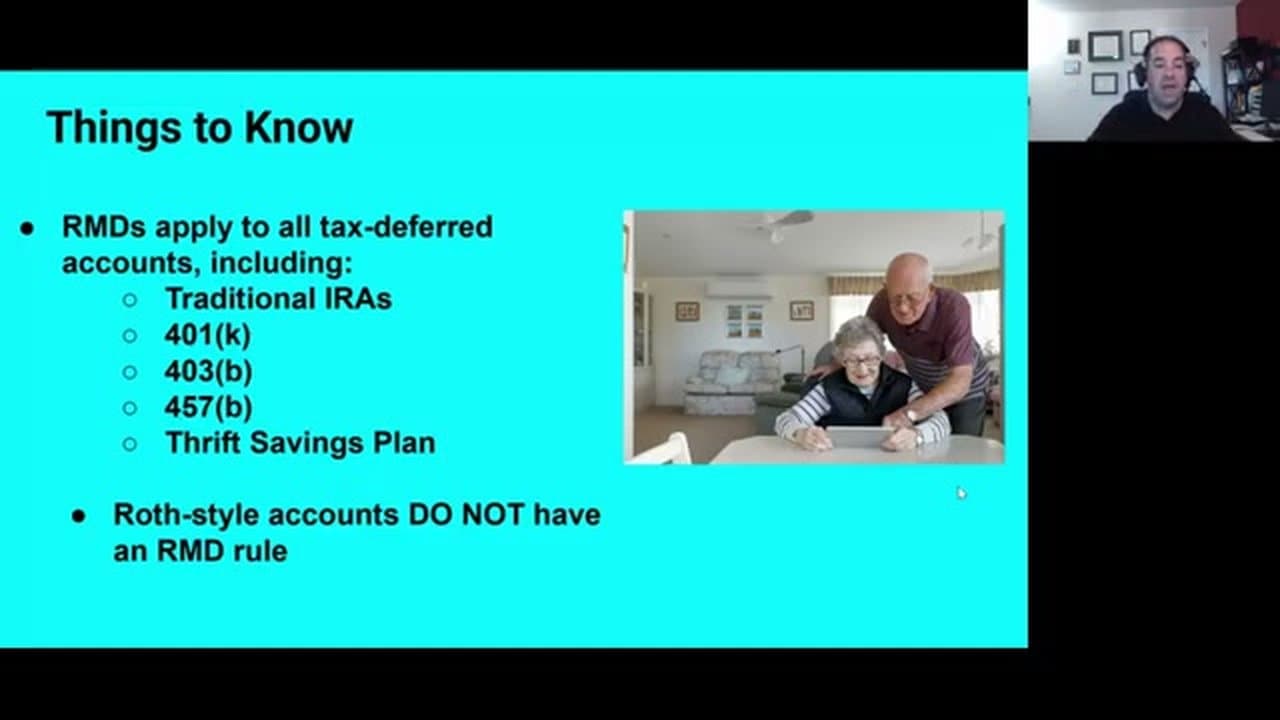
RMDs apply to ALL tax-deferred retirement accounts. That includes traditional IRAs, 401(k)s, 403(b)s, 457(b)s, and Thrift Savings Plan (TSP) accounts. The IRS deferred tax on those contributions when you put the money in - so they want their tax back, eventually, with the RMD as the mechanism.

Roth-style accounts do NOT have RMDs during your lifetime. That covers Roth IRAs, Roth 401(k)s, Roth 403(b)s, and Roth TSP. The reason is simple: you already paid tax on those contributions, so the IRS has nothing left to collect. (Note: Roth 401(k)s used to have RMDs but the SECURE Act 2.0 eliminated that starting in 2024.)

List every retirement account you own and flag the tax-deferred ones. Those are the ones you'll calculate RMDs for in the next steps.

4

Step 4: Check the Aggregation Rules

3:15
Step 4: Step 4: Check the Aggregation Rules

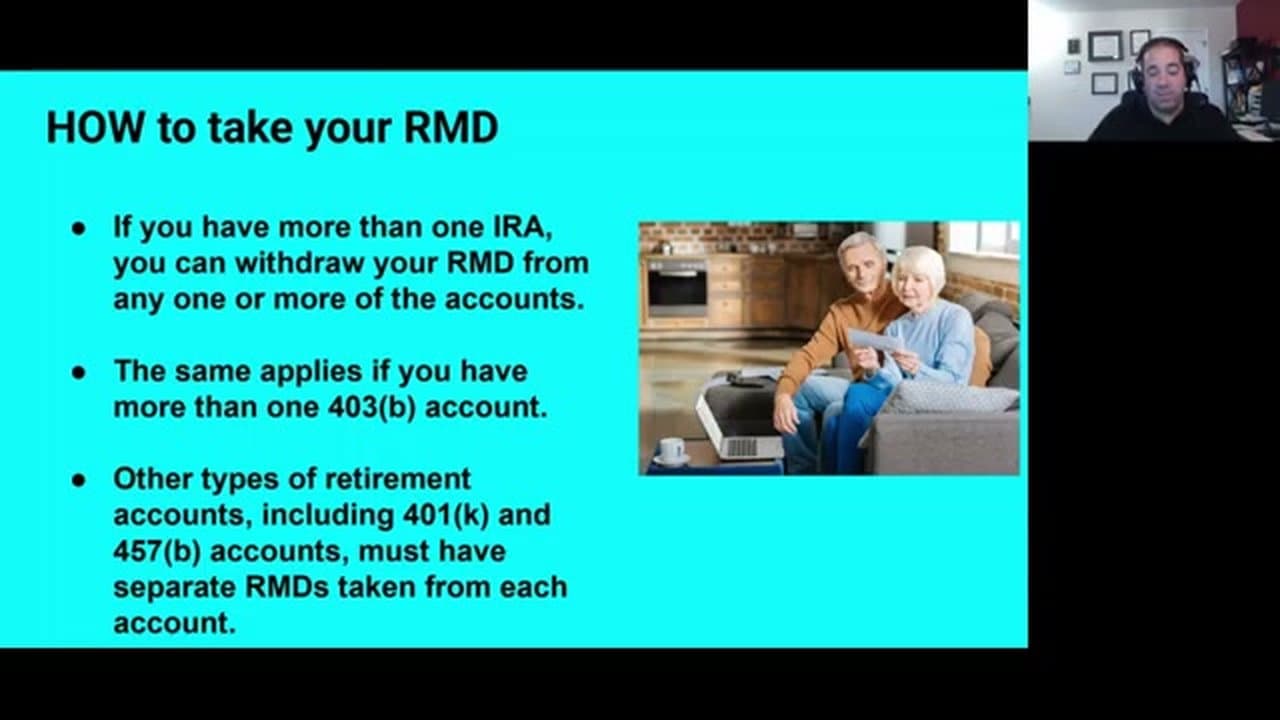
The aggregation rules determine WHICH account(s) you actually pull the money from. If you have multiple traditional IRAs, you can calculate the total RMD across all of them combined, then pull the money from any one (or any combination). Same flexibility for multiple 403(b) accounts.

For 401(k) and 457(b) accounts, the rule is the opposite - you must calculate AND withdraw the RMD separately from each individual account. Five old 401(k)s from prior employers means five separate RMD calculations and five separate withdrawals every year.

Tip

This is one of the cleanest arguments for rolling old 401(k)s into a single traditional IRA after you retire. Five separate 401(k) RMDs become one IRA RMD with one withdrawal a year. The CFP industry calls this "IRA consolidation for RMD simplicity."

5

Step 5: Find Your Year-End Balance and the IRS Table Factor

4:05
Step 5: Step 5: Find Your Year-End Balance and the IRS Table Factor

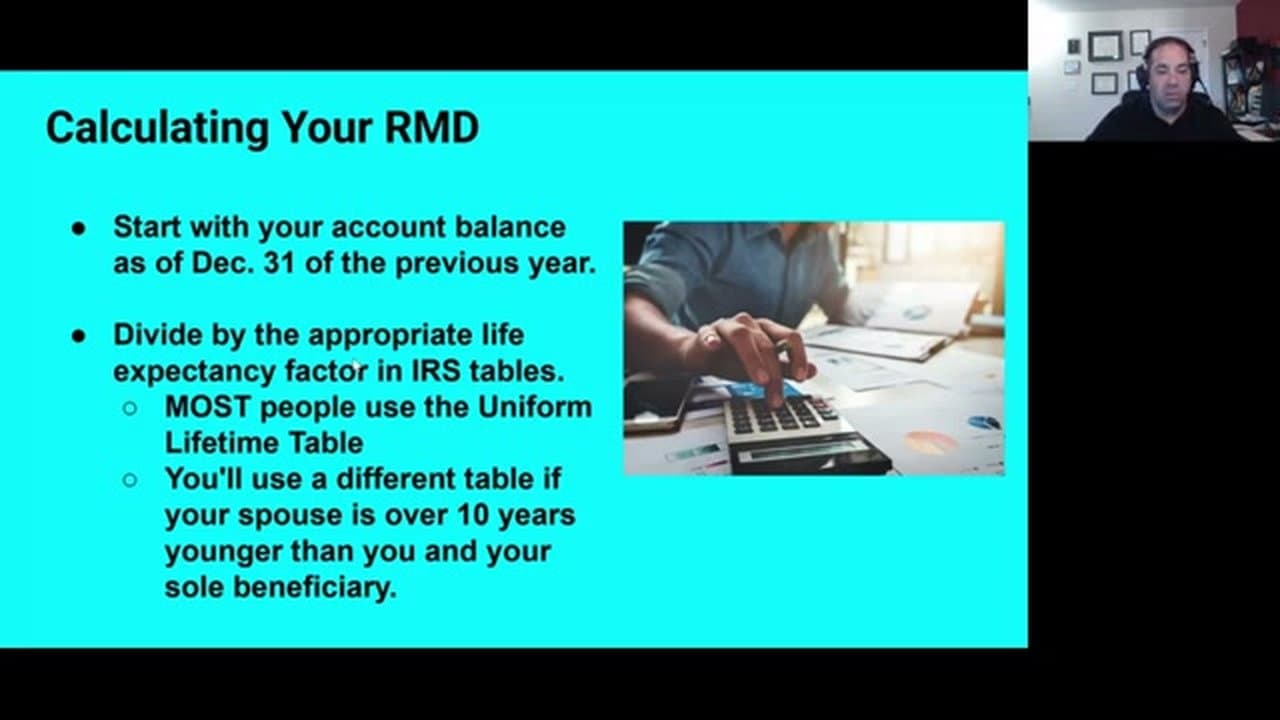
Start with your account balance as of December 31 of the previous year at end of trading day. For a 2025 RMD, that's your balance as of 12/31/2024. You can usually pull this from your brokerage's year-end statement or 1099-R-related documents.

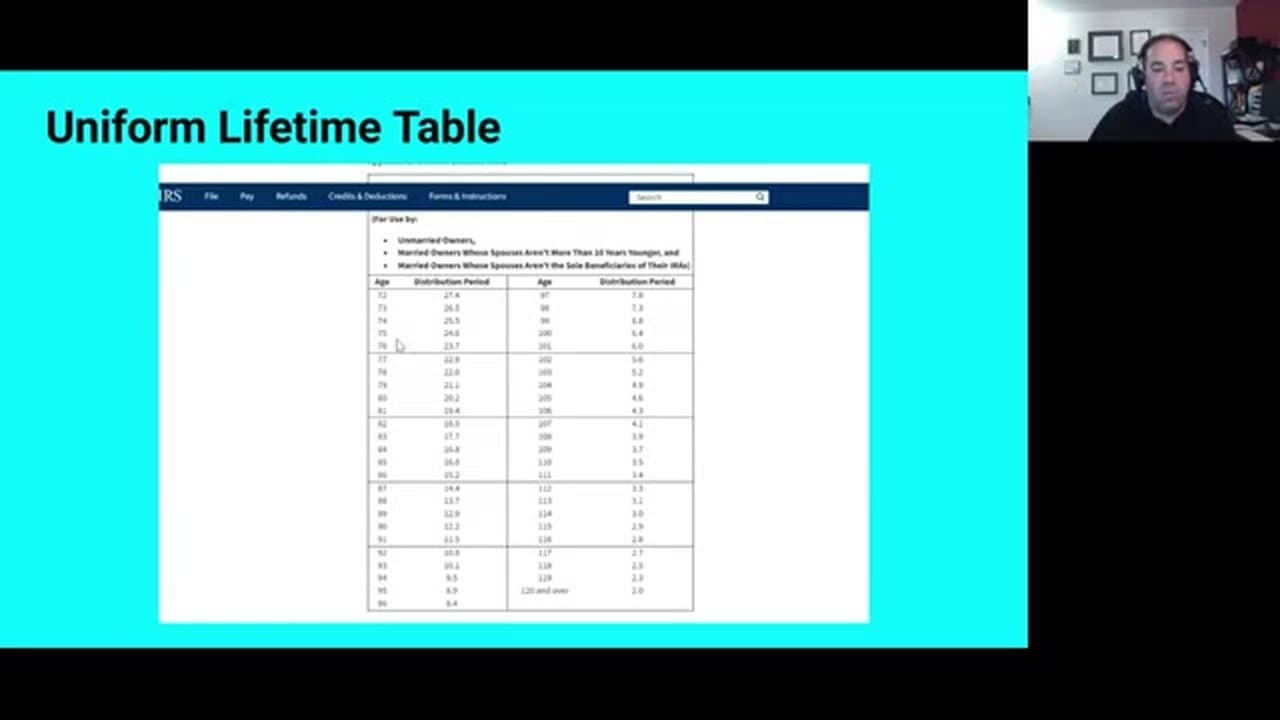
Then look up your age in the IRS Uniform Lifetime Table (found in IRS Publication 590-B). The left column is your age at the end of the current year, the right column is the "distribution period" (also called the life expectancy factor). For age 73 the factor is 26.5. For age 75 it's 24.6. For age 80 it's 20.2. The factor decreases as you age - that's why RMDs grow as a percentage of your account over time.

If your spouse is more than 10 years younger AND is your sole beneficiary on the account, use the IRS Joint Life and Last Survivor Expectancy Table instead. Lower factors, larger RMDs, but the rule only applies in that very specific situation.

Tip

You can search "IRS Publication 590-B Uniform Lifetime Table" directly at IRS.gov - the official table is the authoritative source. Don't rely on a third-party blog's copy that might be outdated.

6

Step 6: Do the Calculation (Worked Example)

5:00
Step 6: Step 6: Do the Calculation (Worked Example)

The calculation is one line of math: prior year-end balance divided by the table factor for your age.

Worked example: you turn 75 in 2025. Your account balance on December 31, 2024 was $500,000. The Uniform Lifetime Table factor for age 75 is 24.6. Your RMD is $500,000 / 24.6 = $20,325. That's the minimum you must withdraw from this account by December 31, 2025.

You can take that $20,325 all at once in December, in monthly $1,694 chunks throughout the year, in two big lump-sum withdrawals, or any combination. The only rule is the total must clear the account by December 31. (Or April 1 of the next year, for your very first RMD only.)

Tip

If you have multiple traditional IRAs aggregating $1,000,000 total at age 75, total RMD is $1M / 24.6 = $40,650. You can pull all $40,650 from just one of the IRAs if that's more convenient - aggregation allows flexible sourcing.

7

Step 7: Know the Penalty for Missing Your RMD

6:00
Step 7: Step 7: Know the Penalty for Missing Your RMD

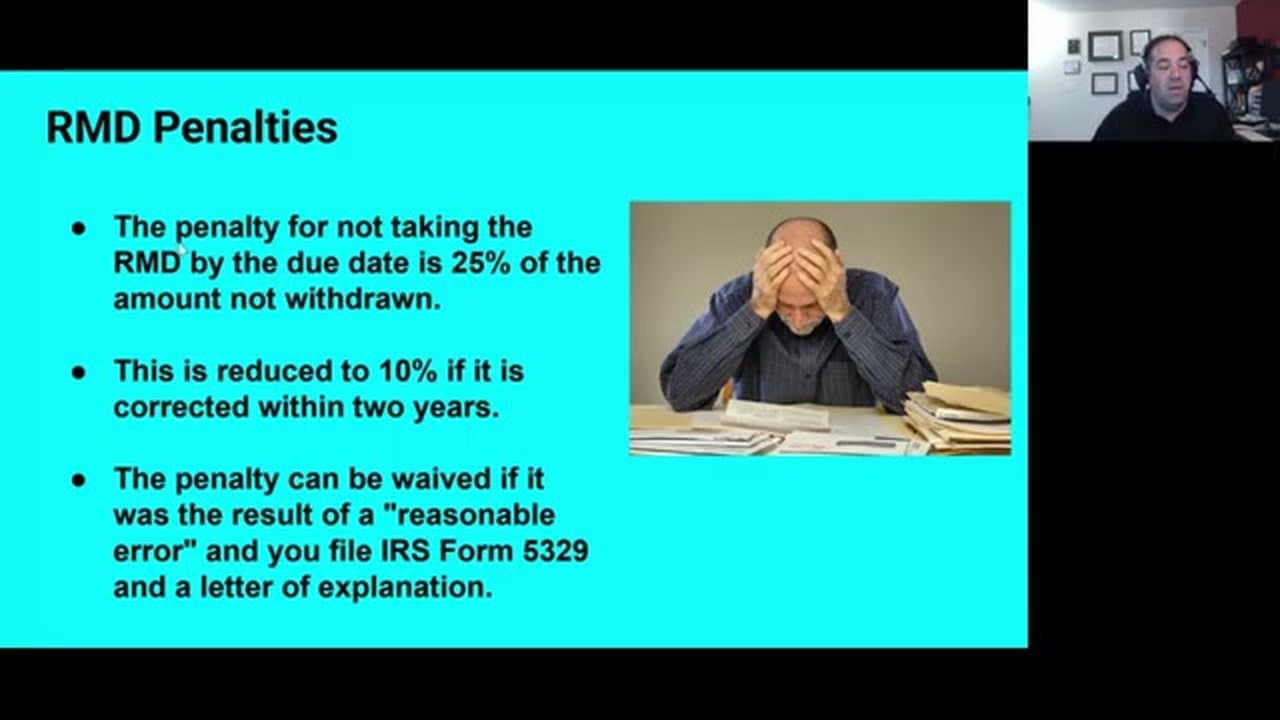
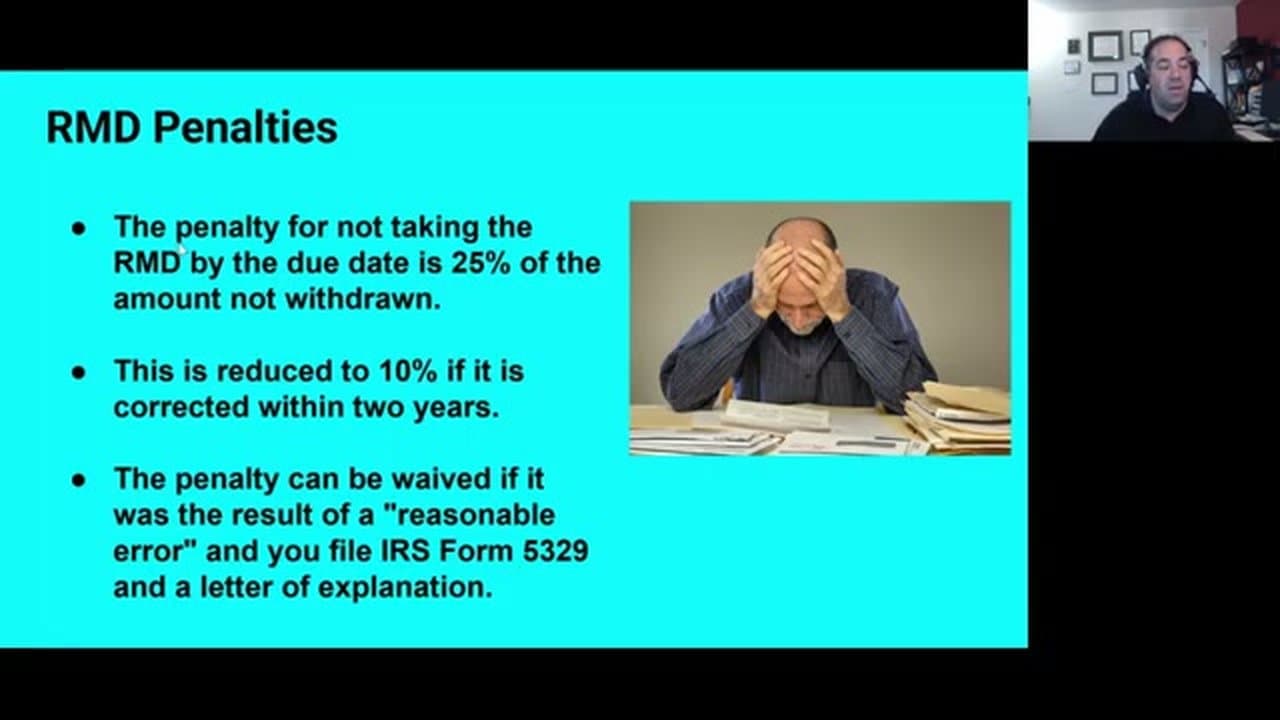
If you miss your RMD deadline, the IRS charges a 25% excise tax on the amount you should have withdrawn but didn't. So a missed $20,000 RMD costs you $5,000 in penalty - on top of the regular income tax you'll still owe when you eventually take the money out.

The penalty drops to 10% if you correct the error within two years. Withdraw the missed amount, then file IRS Form 5329 (Additional Taxes on Qualified Plans) to report and pay the reduced penalty.

In cases of genuine reasonable error (illness, financial-institution mistake, death in the family), the IRS will sometimes waive the penalty entirely if you file Form 5329 with a letter of explanation. Don't rely on this - take the RMD on time. But if it does happen, the waiver process is worth attempting.

Tip

The 25% penalty was 50% before the SECURE Act 2.0 lowered it in 2023. The lower rate is more forgiving but still a serious hit. Set a calendar reminder for November 15 each year to confirm your RMD is taken with 6 weeks of buffer before the December 31 deadline.

Your Guide

Matt Frankel, CFP®

As an Amazon Associate we earn from qualifying purchases. Links on this page may be affiliate links - clicking them and buying doesn't change your price, but helps support ShowMeStepByStep.

Tags

What's next

Weekly Digest

Liked this investing tutorial?

Pick the categories you want to hear about. Weekly digest of new step-by-step tutorials. No spam, easy unsubscribe.

Send me tutorials about

We only email about new tutorials. Easy unsubscribe anytime.