What Is Net Worth? How to Calculate Yours in Minutes

Financial BasicsEasy4:126 steps5-question quiz at endBrowse more →

By ShowMeStepByStepPublished Updated

Based on a video by Preet Banerjee.

Net worth is one number that tells you how you are really doing with money. It is what you own minus what you owe. Add up everything you own, subtract everything you owe, and the result is your net worth. That is the whole formula.

This walkthrough, based on a clear explainer from Preet Banerjee, shows how to list your assets and your liabilities, run the subtraction with a simple worked example, and check the number again a year later to see if you are moving in the right direction. No spreadsheet skills required. If you can add and subtract, you can do this.

Step-by-Step Guide

1

Step 1: What Net Worth Actually Means

0:20
Step 1: Step 1: What Net Worth Actually Means

Net worth is a snapshot of your financial position on a given day. The formula never changes: what you own minus what you owe. The things you own are called your assets. The money you owe is called your liabilities.

That is it. A big paycheck does not decide your net worth, and neither does an expensive car. What matters is the gap between the value of what you hold and the debts hanging over it. Get comfortable with those two words, assets and liabilities, and the rest is arithmetic.


2

Step 2: List Everything You Own

0:47
Step 2: Step 2: List Everything You Own

Start with your assets. Write down each thing you own that has real dollar value and put a number next to it. In the example, Jeremy lists his home at $300,000, his car at $20,000, $5,000 in his checking account, and $15,000 in a tax-free savings account.

Use honest, current values, not what you paid or what you hope to get. Add the column up. Jeremy's assets come to $340,000. That total is the full value of what he owns before any debt is subtracted.

3

Step 3: List Everything You Owe

1:12
Step 3: Step 3: List Everything You Owe

Now do the other side: your liabilities. These are the balances you still owe to someone else. Jeremy writes down a $200,000 mortgage, a $15,000 car loan, $3,000 on credit cards, and a $27,000 student loan.

Include every debt, even the small ones. A forgotten credit card balance quietly drags the number down when you skip it. Add the column up the same way you did with assets. Jeremy's liabilities total $245,000, which is the full amount he owes.

4

Step 4: Subtract to Find Your Net Worth

1:28
Step 4: Step 4: Subtract to Find Your Net Worth

Here is the payoff step. Take your total assets and subtract your total liabilities. For Jeremy, that is $340,000 minus $245,000, which gives a net worth of $95,000.

The result can be positive or negative, and both are useful to know. A positive number means you own more than you owe. A negative one, common early on with student loans or a new mortgage, just tells you where the starting line is. Either way, you now have a single figure that describes your whole financial picture.

5

Step 5: Recalculate a Year Later

2:34
Step 5: Step 5: Recalculate a Year Later

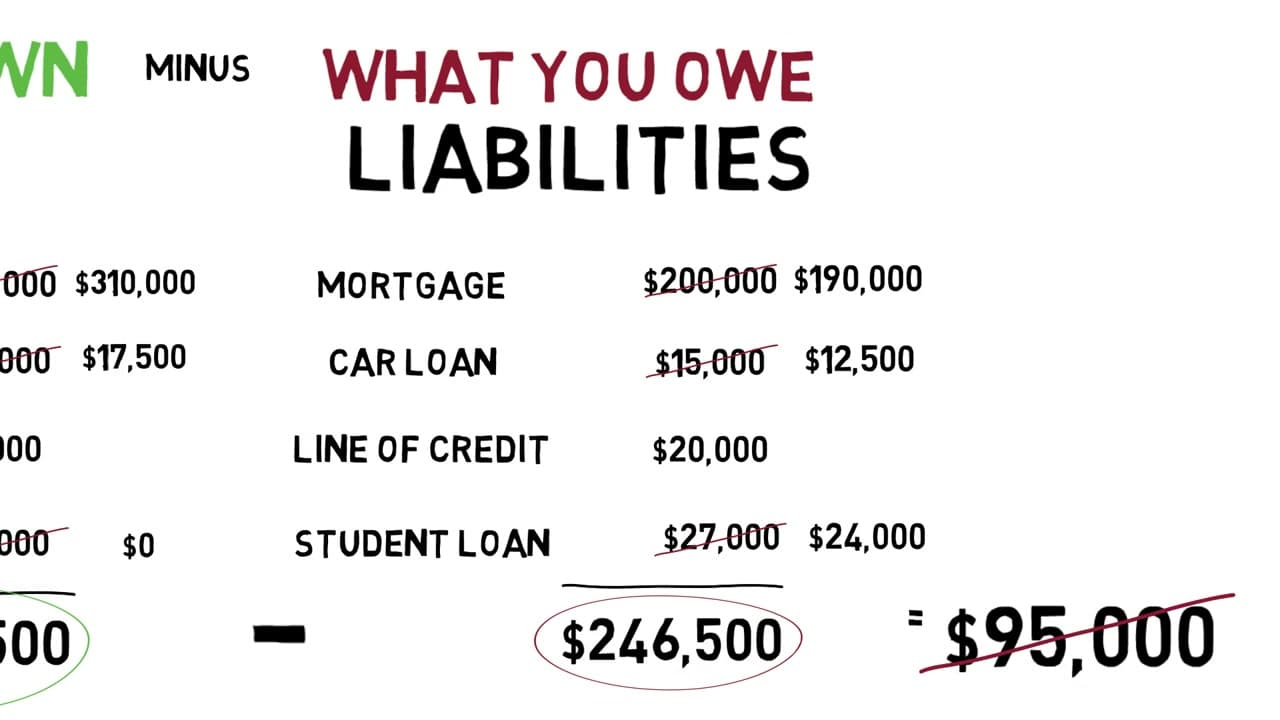
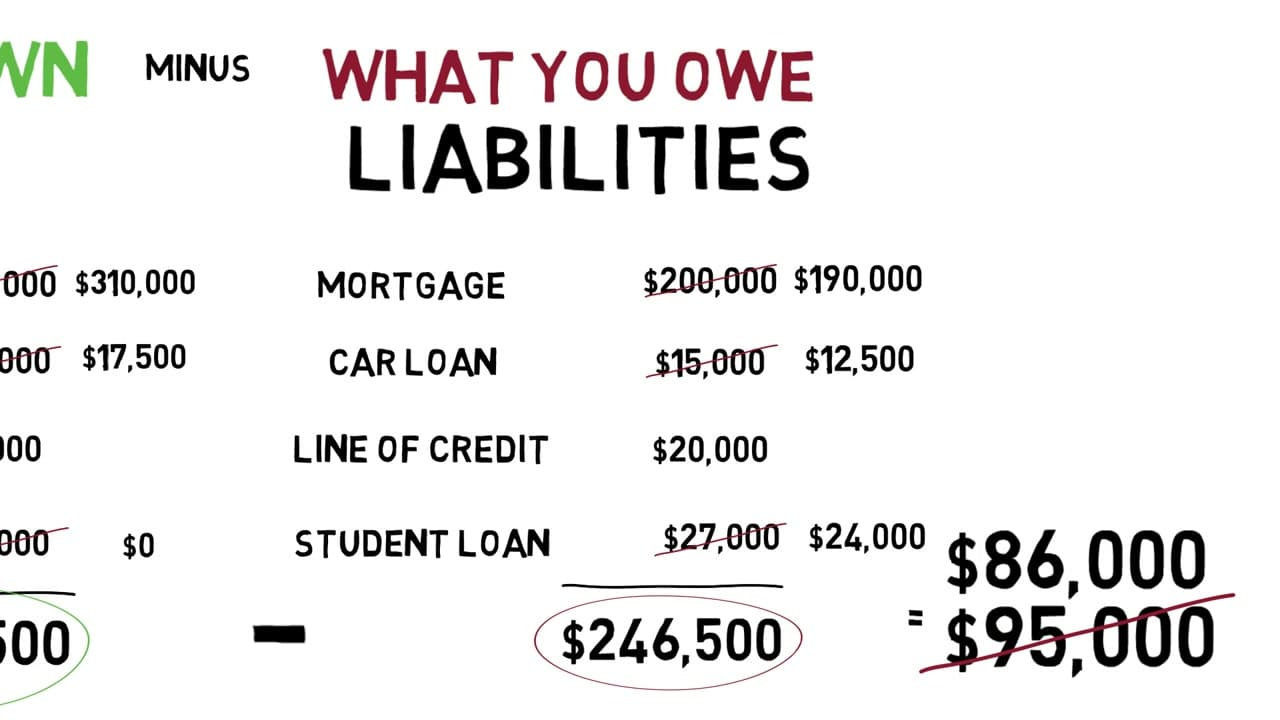
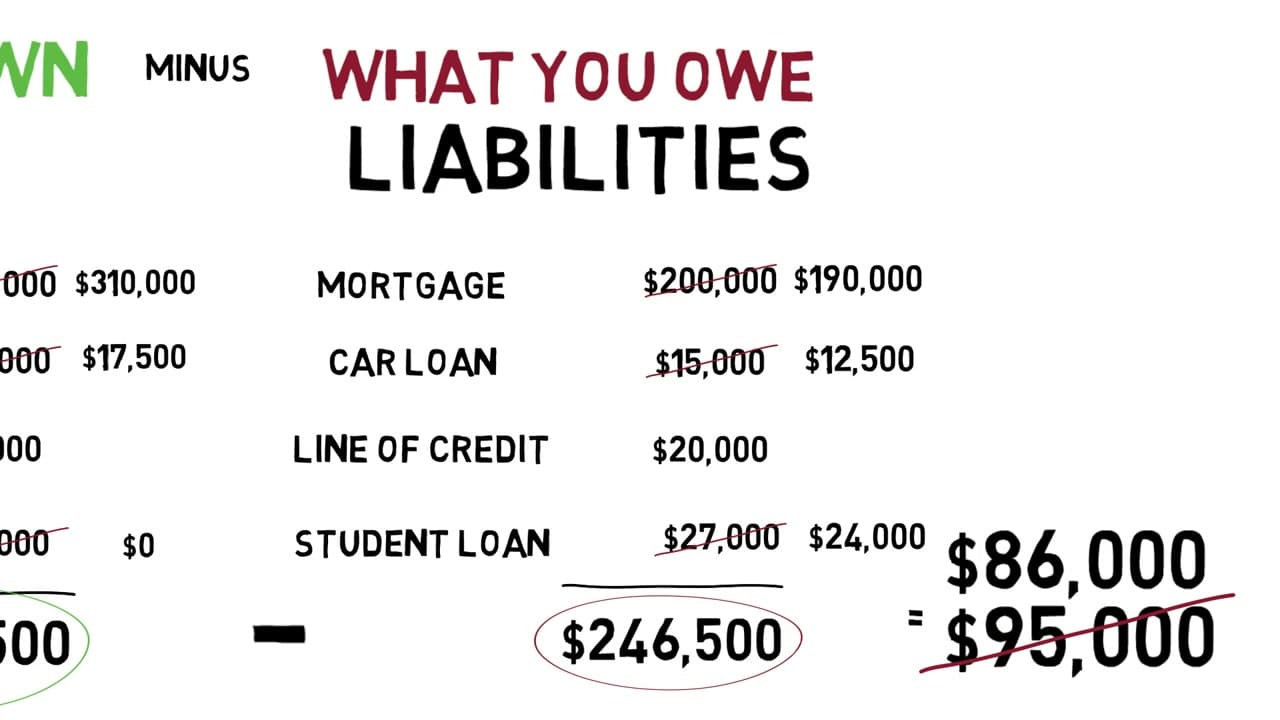
One net worth number is a photo. The real value comes from taking it again, about once a year, and watching how it moves. A year on, Jeremy's house has risen to $310,000 while his car dropped to $17,500, and his savings account is now empty.

His debts shifted too: the mortgage and student loan came down, but a new line of credit added $20,000. Run the same subtraction with the fresh numbers and you get an updated net worth to compare against last year's.

Tip

Pick a set date, like your birthday or January 1st, and calculate net worth on that same day every year. Comparing the same date each time keeps the trend honest.

6

Step 6: Read the Trend, Not Just the Number

2:34
Step 6: Step 6: Read the Trend, Not Just the Number

Jeremy's updated net worth comes to $86,000, which is $9,000 lower than the year before. A drop like that is a signal worth reading, not a reason to panic. Some of it came from a car losing value and savings being spent rather than from poor habits.

Over a working career the goal is a net worth that trends upward, which you push along by growing your assets or shrinking your debts. Big assets like a house or investments swing up and down, so watch the long-term direction rather than any single year.

Your Guide

Preet Banerjee

As an Amazon Associate we earn from qualifying purchases. Links on this page may be affiliate links - clicking them and buying doesn't change your price, but helps support ShowMeStepByStep.

Tags

Test your knowledge

Did the lesson stick? Find out in 2 minutes.

5 quick questions covering what you just read. No signup, no score saved — just a gut check.

Quick reference

Key takeaways from What Is Net Worth? How to Calculate Yours in Minutes

5 questions, answers, and one-line explanations. Tap to expand.

  1. 1.What is the formula for net worth?

    Answer: What you own minus what you owe

    Net worth is total assets minus total liabilities.

  2. 2.Which of these is a liability?

    Answer: The balance on your car loan

    A liability is something you owe, like a loan balance.

  3. 3.Which of these counts as an asset?

    Answer: The money in your savings account

    Assets are things you own, like cash, savings, or property.

  4. 4.Your net worth comes out negative. What does that mean?

    Answer: You owe more than you own right now

    A negative number just means liabilities outweigh assets today, common early on.

  5. 5.Why calculate your net worth again a year later?

    Answer: To see whether you are moving in the right direction

    Tracking the trend over time shows whether your finances are improving.

Did this work for you?

What's next

Related collections

Curated theme pages that include this tutorial.

Weekly Digest

Liked this financial basics tutorial?

Pick the categories you want to hear about. Weekly digest of new step-by-step tutorials. No spam, easy unsubscribe.

Send me tutorials about

We only email about new tutorials. Easy unsubscribe anytime.