What Is Compound Interest? A Beginner's Guide

Financial BasicsEasy10:417 stepsBrowse more →
Also in:Investing

By ShowMeStepByStepPublished

Based on a video by Money with Pennies.

Compound interest is the reason a small amount saved young can turn into real money later. Your interest earns interest, and that snowballs year after year. Money with Pennies walks through it with clean whiteboard drawings, so you can actually see the money grow.

In this guide you will follow the same visuals from the video: a side by side of simple vs compound interest, a wealth curve that bends sharply upward, the Rule of 72 for doubling time, and a look at how small fees quietly eat your returns. No math degree needed.

Watch the full video from Money with Pennies for the walkthrough, then use the steps below as your reference.

Step-by-Step Guide

1

Step 1: What Compound Interest Actually Is

1:28
Step 1: Step 1: What Compound Interest Actually Is

Compound interest is interest earning its own interest. You put money in, it earns a return, and next year that return also earns a return. The video shows this with a picture of money growing while someone sleeps - coins and cash piling up on their own. Left alone long enough, the growth curve bends up instead of climbing in a straight line. That bend is the whole idea. Your money starts doing the work for you.

Tip

The earlier you start, the more years compounding has to snowball. Time matters more than the amount you begin with.

2

Step 2: Simple vs Compound - Meet Kevin and Cindy

3:30
Step 2: Step 2: Simple vs Compound - Meet Kevin and Cindy

Kevin and Cindy both start with $1000 at a 10% rate for 30 years. Kevin earns simple interest, so he gets $100 every year, always on the original $1000. He ends with $4000. Cindy earns compound interest, so each year the interest is calculated on her new, bigger total. She ends with $15,863. Same start, same rate, same time. The only difference is that Cindy's interest kept earning interest.

3

Step 3: How It Builds Year After Year

3:00
Step 3: Step 3: How It Builds Year After Year

Here is the mechanic in slow motion. Year one, $1000 grows to $1100. Year two, the 10% is figured on $1100, not $1000, so you land at $1210. Year three runs on $1210 and gets you to $1331. Each year's total feeds into the next year's calculation. The arrows in the video point from one total to the next, so you can watch the base you earn on get bigger every single year.

Tip

This is why the last few years of a long investment add far more dollars than the first few. The base is much larger by then.

4

Step 4: The Snowball Effect on a Growth Curve

4:12
Step 4: Step 4: The Snowball Effect on a Growth Curve

Plot both people on a chart and the story gets obvious. Kevin's simple-interest line is nearly flat, creeping up to about $4000 over 30 years. Cindy's compound line barely differs at first, then curves hard upward toward $16,000. The gap between the two lines is small early on and huge later. That widening gap is the snowball. It rewards patience, which is why compounding is so powerful for anyone with time on their side.

5

Step 5: The Rule of 72 for Doubling Time

5:12
Step 5: Step 5: The Rule of 72 for Doubling Time

Want a fast estimate of how long it takes to double your money? Divide 72 by your interest rate. At 1%, that is 72 years. At 2%, about 36 years. At 10%, roughly 7.2 years. At 15%, under 5 years. The bar chart in the video shrinks fast as the rate climbs, which shows why the rate you earn matters so much. A savings account at 1% barely doubles in a lifetime.

Tip

Inflation runs around 2%. If your money earns less than that, it is losing buying power even while the balance grows.

6

Step 6: How Fees Quietly Eat Your Returns

10:00
Step 6: Step 6: How Fees Quietly Eat Your Returns

A 1% or 2% fund fee sounds tiny. Over 30 years it is not. The chart stacks five wealth curves for fees of 0%, 0.2%, 1%, 1.5%, and 2%. They start together and fan apart as time passes, because the fee both takes a cut and shrinks the balance that could have compounded. Index funds usually charge under 0.4%, mutual funds often 1-2%, and hedge funds more. Small percentage, big long-term difference.

Tip

Lower fees are not always better if an active fund reliably beats its benchmark, but for most people low-cost index funds win over time.

7

Step 7: Start Now - Small Choices Compound Too

8:00
Step 7: Step 7: Start Now - Small Choices Compound Too

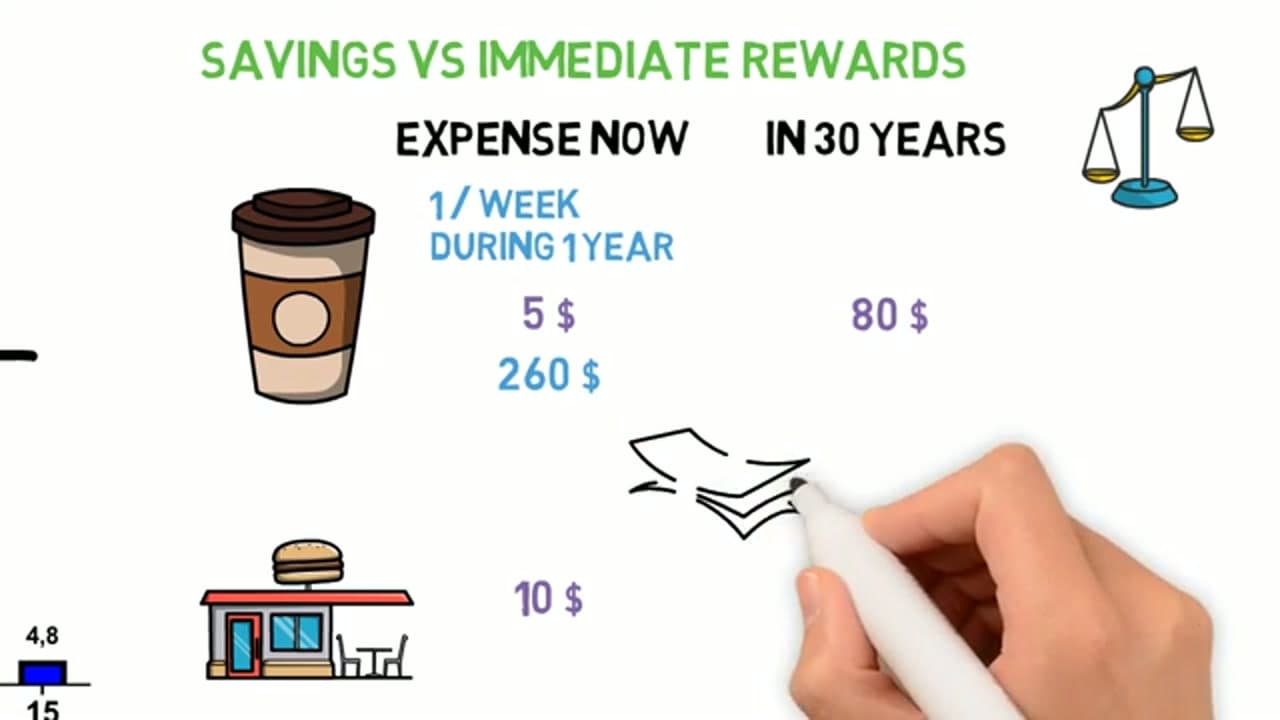
Compounding cuts both ways. A $5 coffee today is money that could have grown to about $80 in 30 years if invested. Buy one every week for a year and that is $260 spent instead of saved. The point is not to skip every treat. It is to see that small, regular amounts add up when you give them time. Start with what you can, stay consistent, and let the years do the heavy lifting.

Your Guide

Money with Pennies

As an Amazon Associate we earn from qualifying purchases. Links on this page may be affiliate links - clicking them and buying doesn't change your price, but helps support ShowMeStepByStep.

Tags

Sunday How-To

New financial basics tutorials, every Sunday

One short email with the week's best step-by-step guides. Free, no spam, unsubscribe anytime.

Did this work for you?

What's next

Weekly Digest

Liked this financial basics tutorial?

Pick the categories you want to hear about. Weekly digest of new step-by-step tutorials. No spam, easy unsubscribe.

Send me tutorials about

We only email about new tutorials. Easy unsubscribe anytime.