How Is Social Security Taxed?

InvestingMedium13:217 stepsBrowse more →

By ShowMeStepByStepPublished Updated

Based on a video by Ted Erhart, CFP®.

If you are newly retired or about to be, one of the first questions you will run into is whether the IRS gets to tax your Social Security check. The honest answer: sometimes yes, sometimes no, and it comes down to your total income for the year. This walkthrough is built around a clear breakdown by Ted Erhart, a CFP who focuses on retirement planning for people 55 and over.

We will cover the provisional income formula, the three taxation tiers (0%, up to 50%, and up to 85% of benefits taxable), and two worked examples on an actual Form 1040 so you can see how it plays out. If you are also sorting through retirement income decisions, you may want to read our guides on how to calculate your RMD and what Medicare Part B covers, and our walkthrough on filing taxes online with TurboTax. RMDs, Medicare premiums, and Social Security taxation all key off the same line on your return.

Disclaimer: This is general educational content, not personal financial advice. Tax brackets, IRMAA tiers, and Social Security thresholds change, and the right move depends on your specific income mix and state of residence. Before you file or change withholding, consult IRS Publication 915, SSA.gov, or a CFP, CPA, or enrolled agent who knows your full picture.

Step-by-Step Guide

1

Step 1: The Two Questions That Decide If Your Benefits Are Taxed

0:30

Step 1: Step 1: The Two Questions That Decide If Your Benefits Are Taxed

Before you panic about a tax bill on your Social Security check, you only need to answer two questions: how much Social Security did you receive this year, and how much other income did you have? Watch the intro at 0:30. Unlike a single line on your W-2, this decision rides on a small calculation the IRS calls provisional income (you may also hear it called combined income). The IRS publishes a 33-page guide on it (Publication 915), but the working idea fits on a sticky note, and we will lay it out in the next step.

Tip

If Social Security is your only income, you almost certainly owe zero federal tax on it. The taxable piece only shows up once you stack other income like a pension, IRA withdrawals, part-time work, or large investment gains on top.

2

Step 2: Calculate Your Provisional (Combined) Income

1:35
Step 2: Step 2: Calculate Your Provisional (Combined) Income

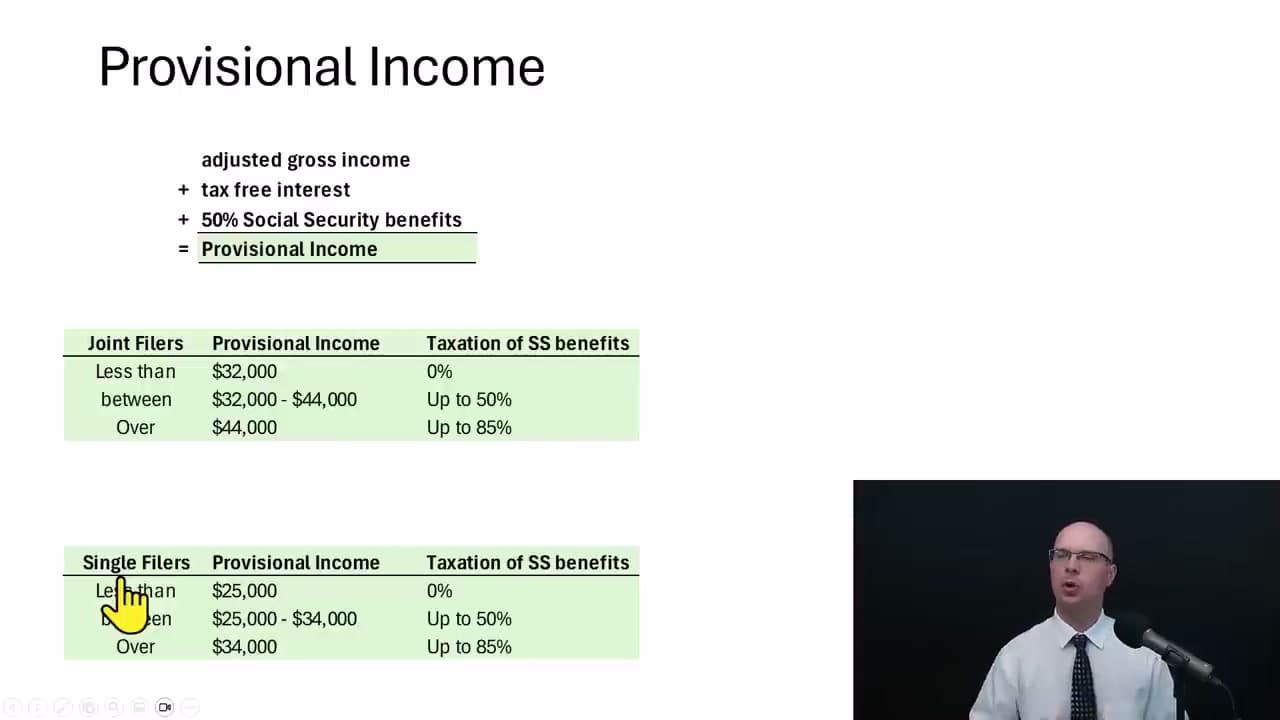
The formula is short. Take your adjusted gross income (AGI) from last year's return, add any tax-exempt interest (municipal bond income usually), then add half of your Social Security benefits. Watch the formula at 1:35. That sum is your provisional income, and it is the number the IRS compares against the income thresholds in the next step. The key thing to notice: the formula uses HALF of your Social Security, not the full amount, which is why high earners get penalized but most middle-income retirees do not.

Tip

If you take a Roth IRA withdrawal, the distribution itself is tax-free AND it does not count as AGI, so it does not bump up your provisional income. That is one of the biggest reasons to fund a Roth before retirement.

3

Step 3: Know the Three Tiers - 0%, Up to 50%, Up to 85%

2:00
Step 3: Step 3: Know the Three Tiers - 0%, Up to 50%, Up to 85%

Once you have provisional income, compare it to the IRS thresholds. Watch at 2:00. For a joint filer: under $32,000, none of your benefits are taxable. Between $32,000 and $44,000, up to 50% can be taxed. Over $44,000, up to 85% can be taxed. For a single filer the brackets are lower: $25,000 and $34,000. These are not hard cliffs. Crossing a threshold by one dollar does not flip all your benefits into the taxable column at once. The phase-in is gradual, and the maximum the IRS can ever tax is 85%. At least 15% of every Social Security check is tax-free no matter how high your income climbs.

Tip

The $32,000 / $44,000 / $25,000 / $34,000 thresholds have not been adjusted for inflation since the 1980s, which is why more retirees end up paying tax on benefits every year. Plan as if they will not change in your lifetime.

4

Step 4: Use the Quick-Reference Grid to Skip the Math

3:55
Step 4: Step 4: Use the Quick-Reference Grid to Skip the Math

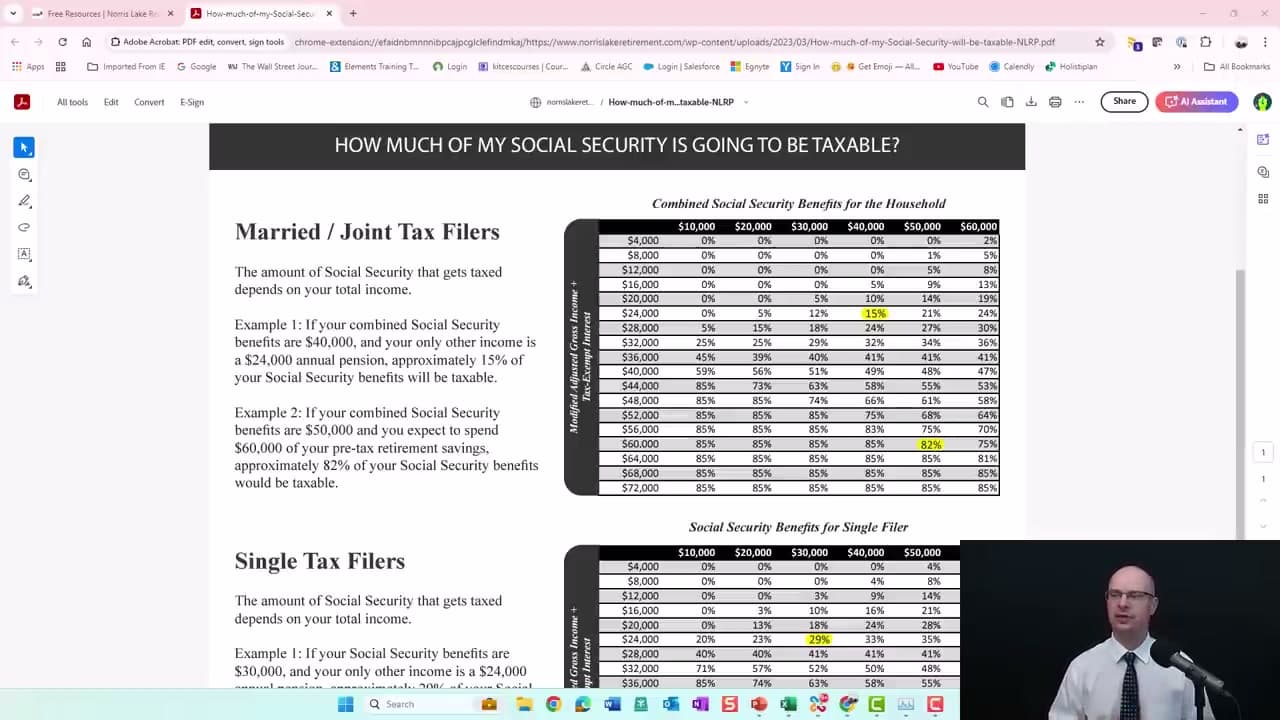
If the formula feels like too much work, Ted built a free PDF that does the lookup for you. Watch the walkthrough at 3:55. The grid is two tables (joint filers up top, single filers on the bottom) showing the percentage of benefits that will be taxable at each combination of Social Security income and other income. Read down the side for your other income (pension + IRA + interest), read across the top for your combined Social Security, and the cell in the middle tells you the taxable percentage. A couple with $40,000 of Social Security and $24,000 of other income lands on 15% taxable. Same couple at $60,000 Social Security and $60,000 other income lands at 82%.

Tip

The grid tells you what percentage is taxable, not what you will actually owe. Tax owed depends on your deductions and brackets after the taxable portion is added in. Use the grid for awareness, then run the full numbers (or have your CPA do it) before December 31.

5

Step 5: Example 1 - Charlie and Nancy at 15% Taxable

6:00
Step 5: Step 5: Example 1 - Charlie and Nancy at 15% Taxable

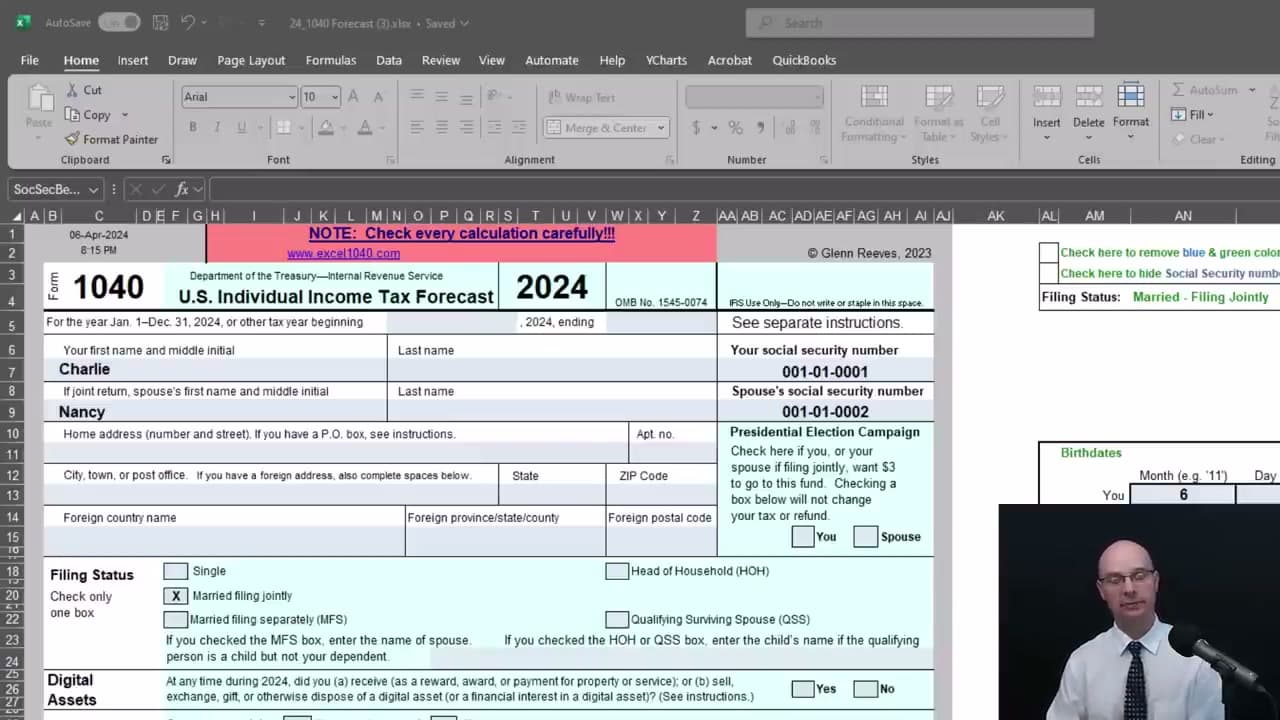
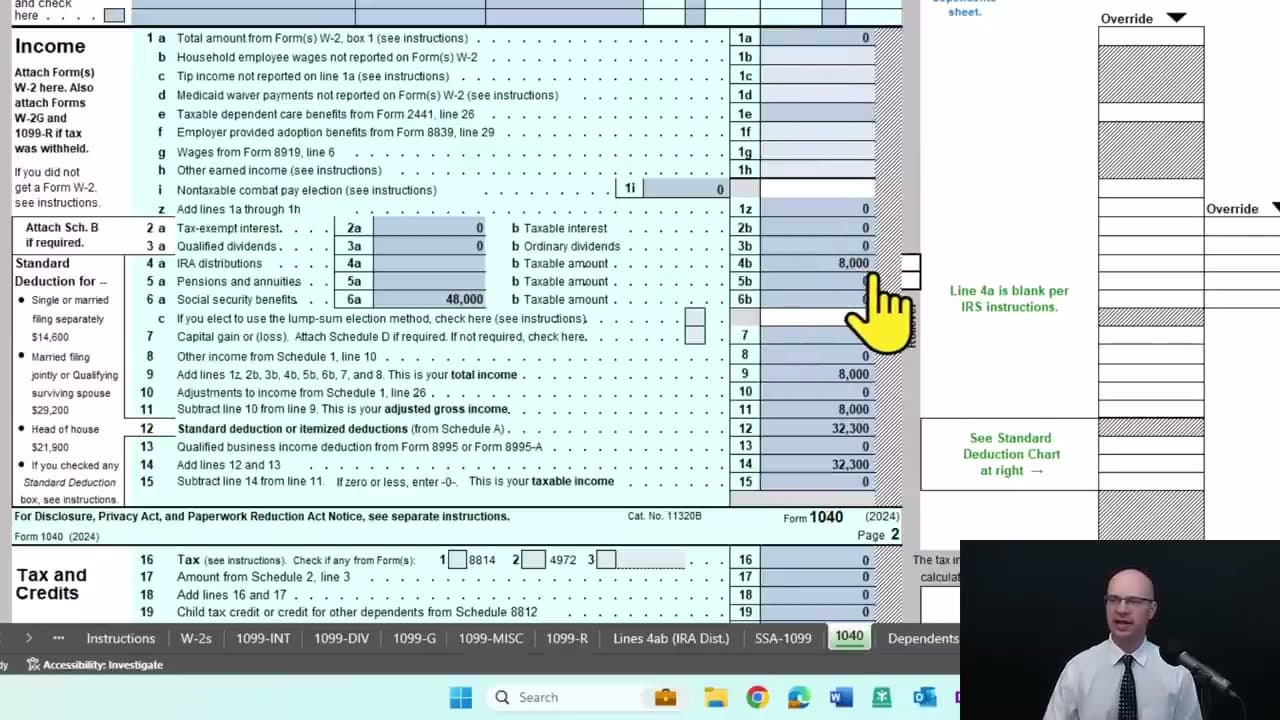
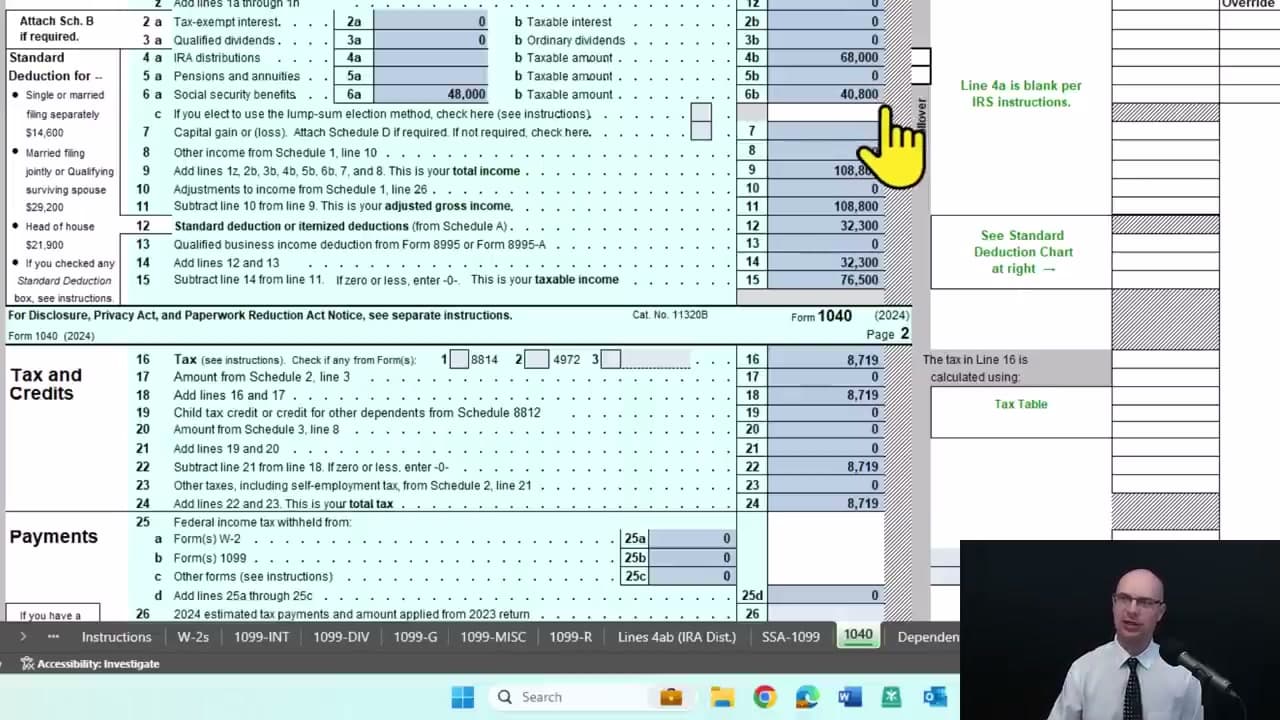
Watch the 1040 walkthrough at 6:00. Charlie and Nancy are both retired and 65. They receive $40,000 of Social Security and take $24,000 out of a pre-tax IRA. The grid said 15% of their benefits would be taxable, and the 1040 confirms it: $6,000 of taxable Social Security shows up on line 6b. Add the $24,000 IRA distribution on line 4b and their AGI lands at $30,000. Here is the surprise: the 2024 standard deduction for a married couple both age 65+ is $32,300. Their deduction is BIGGER than their total income, so their taxable income is zero and they owe no federal income tax this year. Some of their Social Security is technically taxable, but it does not generate a tax bill.

Tip

The standard deduction is HIGHER once you turn 65. For 2024 it is $32,300 for a married couple both 65+, $16,550 for a single 65+ filer. Many retirees stop itemizing once they hit Medicare age because the bigger standard deduction wins.

6

Step 6: Example 2 - The Tax Torpedo Zone

9:00
Step 6: Step 6: Example 2 - The Tax Torpedo Zone

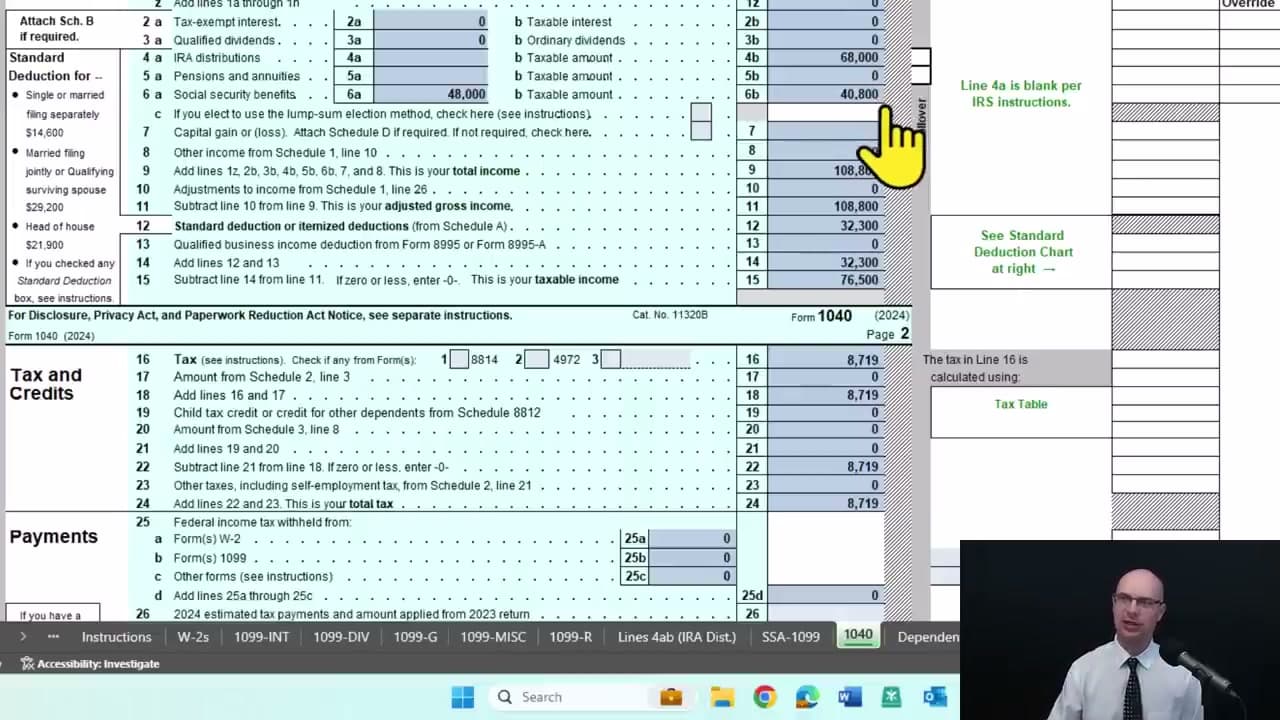
This is the pitfall most retirees do not see coming. Watch at 9:00. Same couple, but now Charlie pulls an extra $60,000 from his IRA mid-year to buy a vehicle. That one decision drags his Social Security into the 85% taxable column, so his gross income on the 1040 jumps from $8,000 to $108,800. Sixty thousand of withdrawal turned into more than one hundred thousand of taxable income, because the extra IRA dollar got taxed AND it pulled previously tax-free Social Security into the taxable column. That double whammy is the Social Security tax torpedo. Anyone whose provisional income lands between the 0% and 85% phase-in zone is vulnerable to it. Once you are already at the 85% max, additional income only triggers regular tax (no more SS torpedo).

Tip

If you need a big one-time chunk of cash (new car, roof, medical bill), ask your CPA whether splitting the withdrawal across two tax years - some in December, some in January - keeps you out of the torpedo zone. The same dollar amount taken in one year can cost noticeably more in tax than the same total spread across two.

7

Step 7: Withholding, State Taxes, and Where to Verify the Rules

12:15
Step 7: Step 7: Withholding, State Taxes, and Where to Verify the Rules

Watch the closing summary at 12:15. Three practical follow-ups. First, if you expect to owe federal tax on your benefits, file Form W-4V with the Social Security Administration to have 7%, 10%, 12%, or 22% withheld directly from each check. It is easier than quarterly estimated payments. Second, check your state. Most states do not tax Social Security at all, but a small handful still do (the list shrinks every year, so verify for the year you are in). Third, the source of truth for federal rules is IRS Publication 915, which has the full worksheet and the lump-sum-election rules if you received back benefits. For your personal numbers, plug them into the IRS Interactive Tax Assistant on irs.gov or talk to a CFP, CPA, or enrolled agent.

Tip

Form W-4V can only withhold at 7%, 10%, 12%, or 22%. You cannot pick a custom percentage. If those buckets do not match your bracket, pair W-4V with quarterly estimated payments (Form 1040-ES) to fine-tune.

Products Used

Your Guide

Ted Erhart, CFP®

As an Amazon Associate we earn from qualifying purchases. Links on this page may be affiliate links - clicking them and buying doesn't change your price, but helps support ShowMeStepByStep.

Tags

What's next

Related collections

Curated theme pages that include this tutorial.

Weekly Digest

Liked this investing tutorial?

Pick the categories you want to hear about. Weekly digest of new step-by-step tutorials. No spam, easy unsubscribe.

Send me tutorials about

We only email about new tutorials. Easy unsubscribe anytime.